

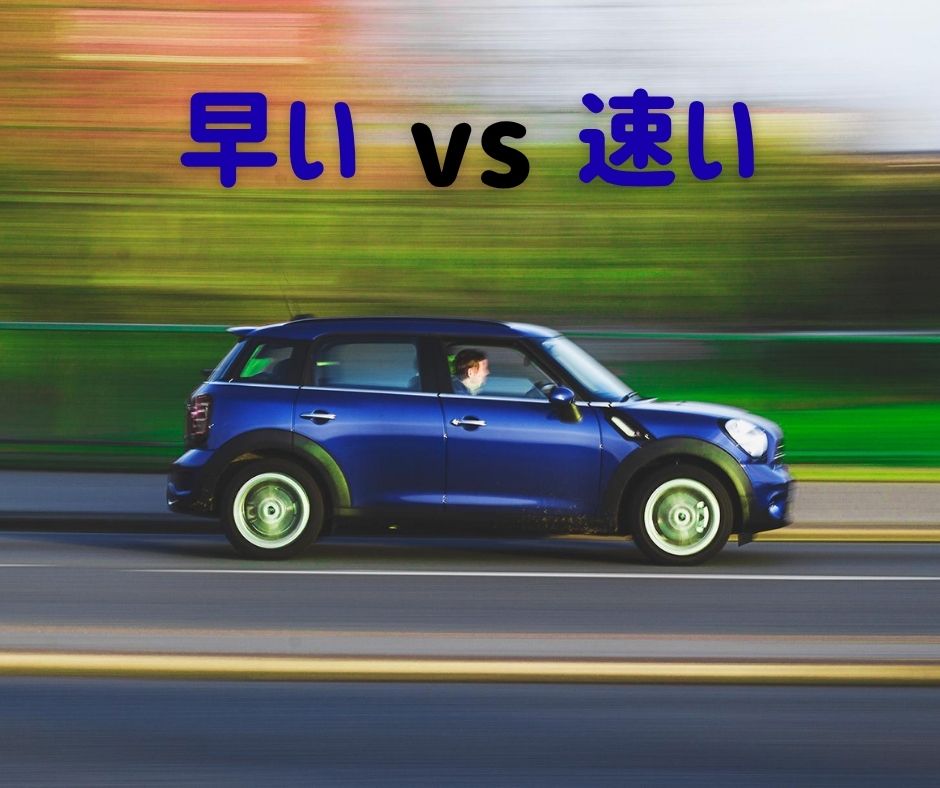
Have you ever wondered why Japanese has two kanji for hayai? 🤔
Both are pronounced the same, but 速い(はやい) and 早い(はやい) are used in different situations!
One is about speed, while the other is about time. Let’s learn how to tell them apart with simple explanations and example sentences!
① 速い — Fast / Quick
Use 速い(はやい) when talking about the speed of movement or how quickly someone does something.
It focuses on how much time it takes to move or complete an action.
Examples:
- 車が速いです。
→ The car is fast. - 彼は走るのが速いです。
→ He runs fast. - この電車はとても速いです。
→ This train is very fast. - 仕事が速いですね!
→ You’re quick at your work! - 彼は食べるのが速いです。
→ He eats quickly.
Common expressions:
- 速い車 → a fast car
- 速いスピード → high speed
- 足が速い → to run fast / have fast legs
② 早い — Early / Soon
Use 早い(はやい) when talking about time. It describes something that happens early, sooner than expected, or before the usual or expected time.
It focuses on when something happens, rather than how fast it happens.
Examples:
- 毎朝、早く起きます。
→ I get up early every morning. - まだ9時です。早いですね。
→ It’s only 9 o’clock. It’s still early! - もう帰るの?早いね!
→ You’re going home already? That’s early! - 今年も終わるのが早いですね。
→ This year is going by so quickly! - 早く来てください。
→ Please come early / Please come soon.
Common expressions:
- 早起き → getting up early
- 早朝→ early morning
- 早い時間 → an early time
- 気が早い → to be impatient / to get ahead of oneself
💡 What About “早い” Meaning “Quickly”?
You might notice that 早い(はやい) can sometimes be translated as “quick” or “quickly” in English.
For example:
- もう宿題が終わったの?早いね!
→ You’ve already finished your homework? That was quick!
Here, 早い(はやい) describes how soon the homework was finished compared with what was expected. The focus is on the timing, not necessarily the speed of the action itself.
Compare these two sentences:
- 彼は走るのが速いです。
→ He runs fast. (His running speed is high.) - 彼は朝早く走ります。
→ He runs early in the morning. (The time is early.)
The kanji changes depending on what you want to emphasize!
🧠 Easy Way to Remember
🏃 速い(はやい) = Speed → How fast does it move or happen?
🕒 早い(はやい) = Time → How early or soon does it happen?
✏️ Let’s Practice!
Choose the correct kanji: 速い(はやい) or 早い(はやい)?
1. この電車はとても( )です。
→ This train is very fast.
2. 毎朝、( )起きます。
→ I get up early every morning.
3. 彼女は歩くのが( )です。
→ She walks fast.
4. もう昼ごはんを食べたの?( )ね!
→ You’ve already eaten lunch? That was quick!
✅ Answers
1. 速い(はやい)
2. 早く(はやく)
3. 速い(はやい)
4. 早い(はやい)