
 September 2, 2025
 No Comments
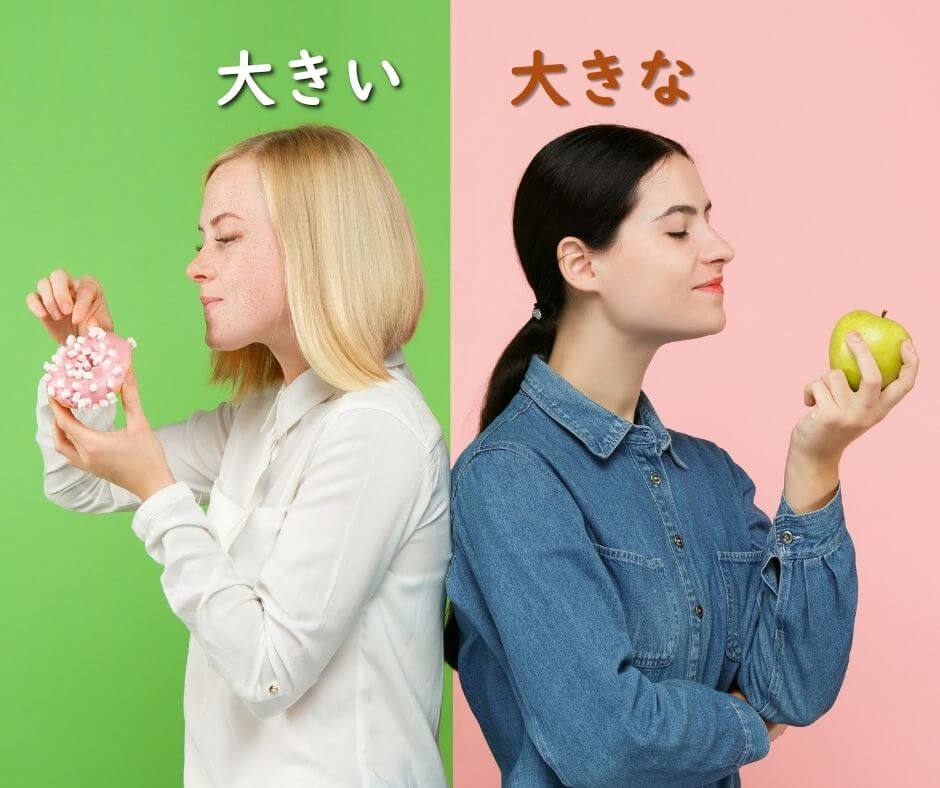
大きい vs 大きな: Which One is Correct?
When learning Japanese, you might notice something confusing: sometimes people say 大きい (ookii), and other times you’ll see 大きな (ookina). Both seem to mean big, so which one is correct? Let’s break it down.
1. The Basic Meaning
- 大きい (ookii) is the standard adjective meaning big, large.
- 大きな (ookina) is a slightly different form that also means big, large.
So at first glance, they look the same. But the way they are used can feel a little different.
2. How They Are Used
大きい
This is the regular い-adjective form. You can use it before a noun, or at the end of a sentence.
- 大きい家 – a big house
- この犬は大きい。 – This dog is big.
大きな
This form works only before nouns. It does not appear at the end of a sentence.
- 大きな問題 – a big problem
- 大きな声 – a loud voice
You cannot say:
✖ この犬は大きな。 (wrong)
3. What’s the Difference in Nuance?
The difference is subtle, and even many native speakers don’t think about it consciously.
- 大きい → neutral, normal description (big in size)
- 大きな → a bit more literary, formal, or emotional. It can make the expression feel more impressive or serious.
For example:
- 大きい箱 – a physically big box.
- 大きな夢 – a big dream (sounds more poetic or emotional than 大きい夢).
In daily conversation, both are correct, and often interchangeable.
4. Which One Should You Use?
- In everyday conversation: use 大きい.
- In writing, speeches, or when you want to sound expressive: you might choose 大きな.
Both are correct, so don’t stress too much. Many times, either one will be perfectly fine.
5. Quick Comparison
| Usage | 大きい | 大きな |
|---|---|---|
| Before nouns | ✅ | ✅ |
| At the end of sentences | ✅ | ✖ |
| Nuance | Neutral, standard | Literary, emotional |
| Example | 大きい家 (a big house) | 大きな夢 (a big dream) |
6. Final Tip
Think of 大きな as a “special flavor” of 大きい. If you stick with 大きい, you’ll always be safe. Once you get more comfortable, you can start using 大きな to give your Japanese more nuance and style.
✨ Summary:
大きな = only before nouns, adds a literary or emotional touch.
大きい = standard, safe choice.
If you want to learn Japanese, improve your skills, or connect with native speakers and other learners, we can help. We offer one-on-one lessons, a supportive community, and on demand courses.
Website: nihongonana.com
Email: support@nihongonana.com
✅Book 1-on-1 lessons: https://nihongonana.com/lessons/
✅Join our Speaking Club: https://nihongonana.com/community/
✅Join our Course Waitlist: https://nihongonana.com/courses/
Recent Posts
-

No More Confusion :…
March 12, 2026
-

Remembering What Happened on…
March 11, 2026
-

More Different Practical Ways…
March 10, 2026
-
The Simple Taste of…
March 9, 2026
-
Why Japanese People Use…
March 7, 2026
Leave Comment