
 March 12, 2026
 No Comments
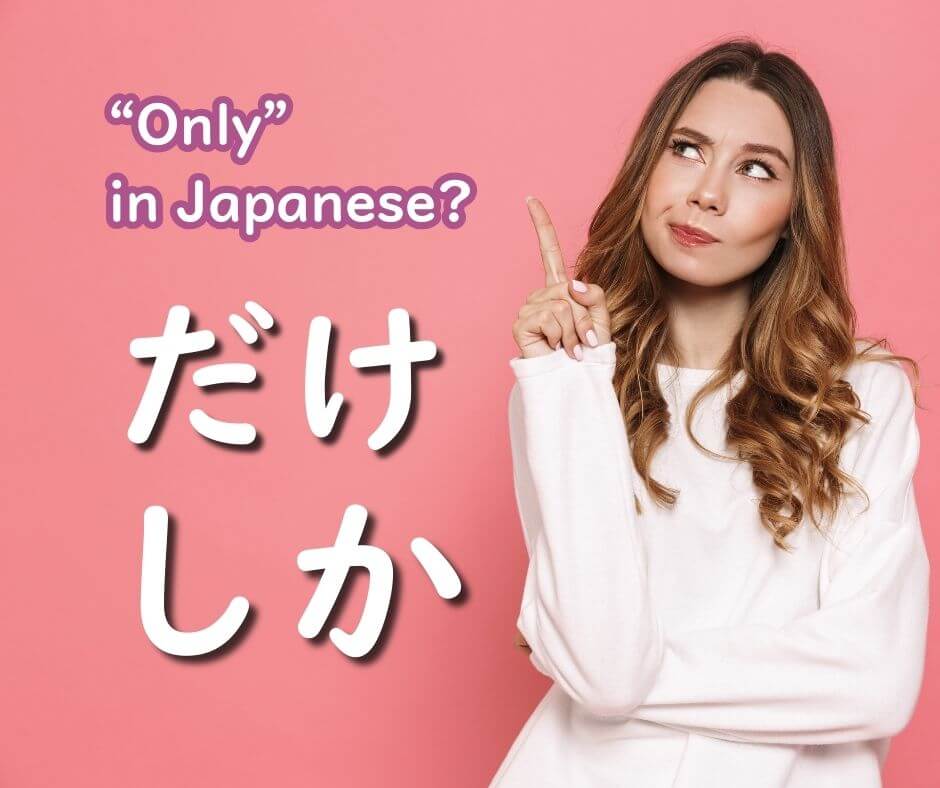
No More Confusion : だけ and しか Made Easy
If you study Japanese for a while, you will quickly notice that both だけ and しか are used to express the idea of “only.” However, Japanese speakers do not use them in exactly the same way. The grammar structure and the nuance are different.
Let’s break it down step by step together!
1. だけ: Simply “Only”
The Japanese word だけ means “only” or “just.” It simply states that something is limited to that amount or item.
Example:
私は水だけ飲みます。
I drink only water.
Here, the meaning is very neutral. The speaker is simply saying water is the only thing they drink.
More examples:
今日は日本語だけ勉強しました。
Today I studied only Japanese.
彼だけ来ました。
Only he came.
In these sentences, だけ simply indicates limitation.
2. Using しか: “Nothing But / Only” with Negatives
The word しか also expresses the idea of “only.”
But there is one important rule: しか must always be used with a negative verb.
Example:
水しか飲みません。
I drink only water.
Even though the sentence is negative grammatically, the meaning is similar to the だけ example earlier.
However, しか often carries a stronger feeling of limitation. It can sound like:
nothing but
only this and nothing else
More examples:
今日は日本語しか勉強しませんでした。
Today I studied nothing but Japanese.
彼しか来ませんでした。
No one came except him.
3. Comparing だけ and しか
Let’s compare the same idea with both patterns.
水だけ飲みます。
I only drink water.
水しか飲みません。
I drink nothing but water.
Both sentences are correct and very similar in meaning.
However, しか tends to emphasize the restriction more strongly, while だけ feels more neutral and affirmative.
4. A Small Nuance Difference
Sometimes the difference becomes clearer with context.
Example:
千円だけあります。
I only have 1000 yen. (neutral)
千円しかありません。
I have only 1000 yen. (and that’s not much)
Because しか uses the negative form, it often sounds like the amount is insufficient or disappointing.
This nuance is very common in everyday Japanese.
5. Quick Rule to Remember
You can remember it with this simple rule:
✅だけ → can use positive verbs
✅しか → must use negative verbs
Examples:
りんごだけ食べました。
I ate only apples.
りんごしか食べませんでした。
I ate nothing but apples.
Final Thoughts
Both だけ and しか mean “only,” but the structure and nuance are different.
- だけ → neutral limitation
- しか + negative → stronger limitation or “nothing but”
Once you get used to the negative pattern with しか, this grammar becomes very natural.
And the good news is that Japanese speakers use these two patterns all the time, so you will hear them often in real conversations.
If you have any questions, feel free to leave us a comment! 読んでくれてありがとうございます!(Thank you for reading this!)
If you want to learn Japanese, improve your skills, or connect with native speakers and other learners, we can help. We offer one-on-one lessons, a supportive community, and on demand courses.
Website: nihongonana.com
Email: support@nihongonana.com
✅Book Private Lessons: https://nihongonana.com/lessons/
✅Join our Online Community: https://nihongonana.com/community/
✅Join our Group Courses: https://nihongonana.com/courses/
Recent Posts
-

No More Confusion :…
March 12, 2026
-

Remembering What Happened on…
March 11, 2026
-

More Different Practical Ways…
March 10, 2026
-
The Simple Taste of…
March 9, 2026
-
Why Japanese People Use…
March 7, 2026
Leave Comment