
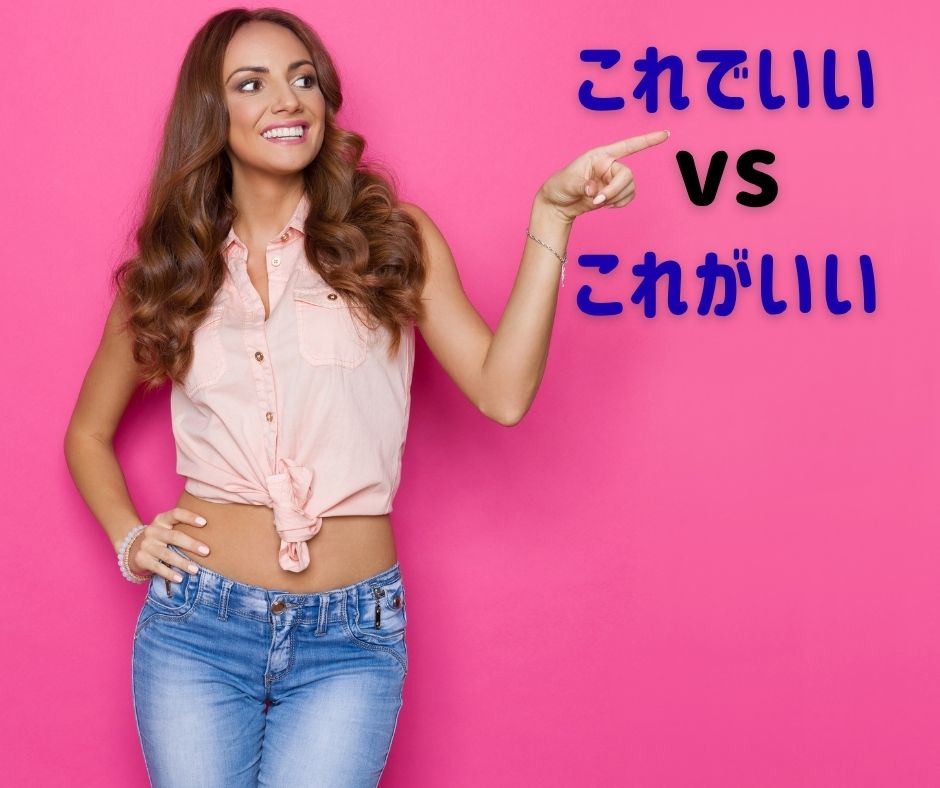
Have you ever wondered about the difference between これでいい and これがいい?
Both expressions are commonly used in everyday Japanese, especially when choosing food, clothes, drinks, or other things.
They may look similar, but they express slightly different feelings!
So, what’s the difference? Let’s learn how to use them naturally in Japanese!
1. これでいい – This Is Fine / This Will Do
これでいい means “This is fine,” “This is good enough,” or “This will do.”
You use it when something is acceptable or sufficient for you. It often gives the feeling that you don’t need anything more or that you’re satisfied with the current option.
Examples:
- これでいいです。
- This is fine.
- 私はこれでいいです。
- This is fine for me.
- この服でいいよ。
- These clothes are fine.
- お水でいいです。
- Water is fine.
When to use it:
Imagine you’re at a café with your friend, and they ask:
「何を飲む?」
(What would you like to drink?)
You don’t have a particular preference, so you answer:
「お水でいいよ。」
(Water is fine.)
You’re saying that water is enough for you. You don’t need anything special.
2. これがいい – I Want This One / This Is the One I Want
これがいい means “I want this one” or “This is the one I like.”
You use it when you have a preference and want to choose something in particular.
It expresses a stronger feeling of wanting or choosing that specific thing.
Examples:
- これがいいです。
- I want this one.
- 私はこれがいいです。
- I prefer this one.
- この服がいい!
- I want these clothes!
- やっぱりこれがいい!
- This is definitely the one I want!
When to use it:
Imagine you’re shopping with your friend, and they ask:
「どの服がいい?」
(Which clothes do you like?)
You find your favorite one and answer:
「これがいい!」
(I want this one!)
You’re choosing it because you like it the most!
3. Compare Them in the Same Situation
Let’s imagine you’re choosing a cake at a bakery.
これでいい。
(This is fine.)
You don’t have a particular preference. This cake looks good enough, so you’re happy with it.
これがいい!
(I want this one!)
You see your favorite cake and choose it because it’s exactly what you want!
The difference is subtle, but the feeling is quite different.
| Expression | Meaning | Feeling |
|---|---|---|
| これでいい | This is fine. | It’s acceptable. |
| これがいい | I want this one. | This is my preference. |
4. Be Careful! The Tone Can Change the Meaning
One interesting thing about Japanese is that これでいい can sometimes sound like you’re settling for something rather than choosing what you really want.
For example:
「これでいいです。」
(This is fine.)
「これがいいです!」
(I want this one!)
However, don’t think that これでいい always sounds negative!
It can simply mean that you’re happy with something and don’t need anything else.
For example:
「これで大丈夫です。」
(This is okay as it is.)
「お水だけでいいです。」
(Just water is fine.)
Both are perfectly natural expressions in everyday Japanese.
5. Quick Quiz! Let’s Check Your Understanding
Let’s try two questions! Choose the correct Japanese expression for each situation.
Question 1. You’re choosing a birthday present. You find something you really love and want to buy it.
A. これでいい!
B. これがいい!
Question 2. Your friend asks if you need anything else. You don’t need anything more.
A. これでいいです。
B. これがいいです。
Answers:
- B. これがいい!
- A. これでいいです。
Final Tip!
Remember this simple difference:
- これでいい = This is fine. / This will do.
- これがいい = I want this one. / This is my preference.
Both expressions are very common in everyday Japanese, so try using them when choosing food, clothes, drinks, or other things!
Want to sound more natural in Japanese? 🇯🇵 Learn the difference between これでいい and これがいい and use them like a native speaker! Join NihongoNana’s Japanese lessons and improve your everyday Japanese!