

 March 27, 2026
 No Comments
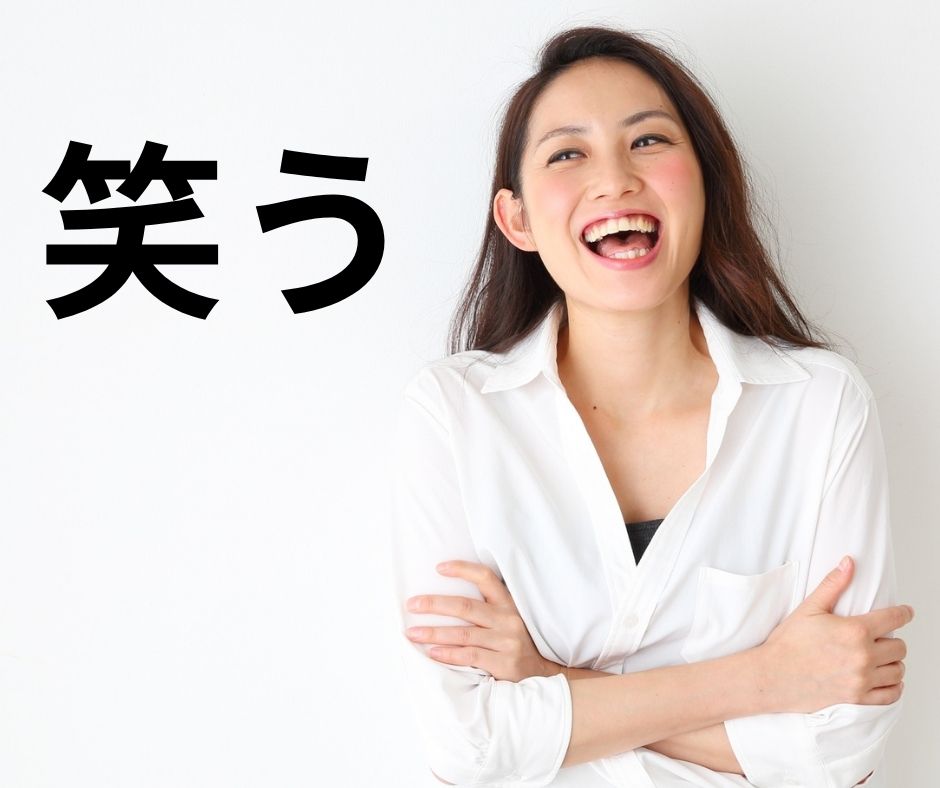
笑う: More Than a Simple “Laugh”— Usage and Meaning
When you learn Japanese, most textbooks translate 笑う simply as “to laugh.”
But here’s the thing:
笑う is not just “laugh.” It can also mean “smile.”
And understanding this subtle difference can completely change how you interpret Japanese.
What Does 笑う Really Mean?
At its core, 笑う describes a positive facial expression.
That expression can range from:
- a big, audible laugh
- to a soft, quiet smile
In English, we clearly separate:
- laugh → voice, sound
- smile → silent, facial expression
But Japanese doesn’t always make that distinction.
👉 笑う covers both.
笑う = Laugh and Smile
Let’s look at how it works in real life.
Example 1
彼は楽しそうに笑っている😆
He is laughing happily.
👉 Could be laughing out loud…
👉 Or just smiling warmly
Example 2
彼女はいつも笑っている☺️
She is always smiling.
In English, “always laughing” sounds a bit strange here.
But in Japanese, 笑う naturally includes “smile.”
Example 3
動画がおもしろくて笑った 😂
The video was funny, so I laughed.
👉 Here, 笑った clearly means “laughed.”
👉 The context (something funny) makes it obvious that it’s not just a smile, but actual laughter.
Why This Matters
If you translate 笑う = laugh every time, you might:
- imagine people laughing loudly when they’re not
- misunderstand tone in conversations
- miss emotional nuance
Sometimes, 笑う is gentle, quiet, and subtle—closer to “smile.”
So When Is It Clearly “Laugh”?
When context makes it obvious, 笑う leans more toward “laugh.”
For example:
- 声を出して笑う → laugh out loud 😂
- 大笑いする → burst out laughing 🤣
These remove ambiguity and emphasize actual laughter.
Want to Say “Smile” More Clearly?
Japanese does have words closer to “smile,” such as:
- 微笑む → a gentle smile ☺️
- 笑顔 → a smiling face 😊
But in everyday conversation, people still often use 笑う.
The Key Takeaway
笑う is more than just “laugh.”
It’s a flexible word that can mean:
- to laugh
- to smile
- or simply to show happiness on your face
👉 Instead of translating directly, think of it as:
“to express happiness through your face.”
Final Thought
This is a great example of why learning Japanese isn’t just about vocabulary—it’s about perspective.
Sometimes, one word in Japanese covers what English splits into two.
And 笑う is a perfect reminder:
Not every “laugh” is loud—and not every smile needs a different word 😊
If you want to learn Japanese, improve your skills, or connect with native speakers and other learners, we can help. We offer one-on-one lessons, group courses and a supportive community!
Website: nihongonana.com
Email: support@nihongonana.com
✅Private Lesson: NihongoNana Private Lessons
✅Group Courses: NihongoNana Courses
✅Online Community: NihongoNana Community
Recent Posts
-

How to Say “Convenient”…
October 16, 2026
-

Tired of Japanese Learning…
October 15, 2026
-

Shopping at MUJI Japan:…
October 14, 2026
-

What Does Yabai Mean…
October 13, 2026
-

Japanese School System and…
October 12, 2026
Leave Comment