
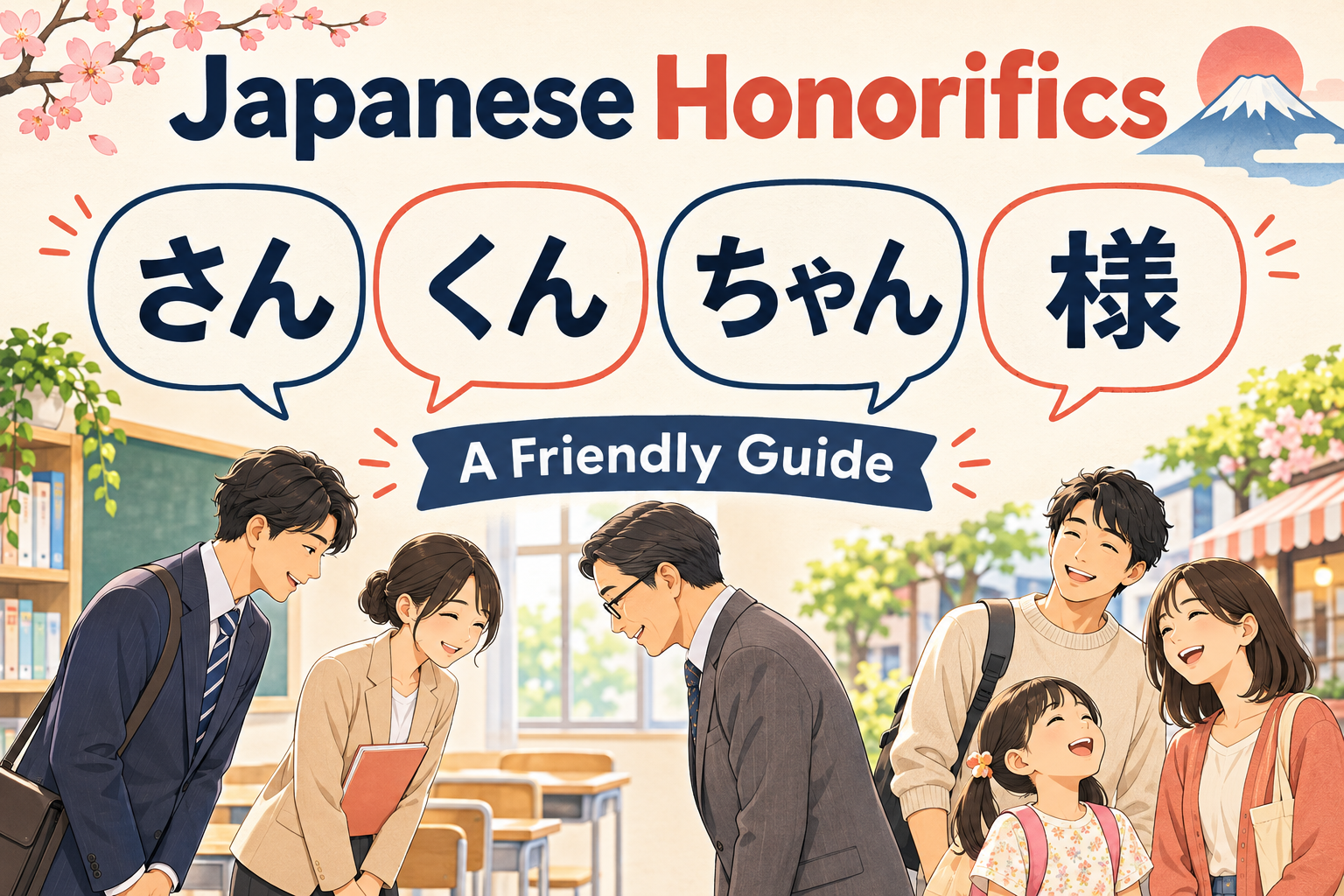
Japanese honorifics are the short endings and titles you use with people’s names to show respect, familiarity, or affection. You have probably heard さん, くん, ちゃん, and 様 in Japanese conversations, dramas, or anime. But which one should you actually use?
The safest starting point is the person’s family name + さん. From there, consider your relationship, the setting, and what the person prefers. This guide explains the main choices with everyday examples and a mini quiz.
Reading tip: Use the Furigana switch above to show or hide the small readings over kanji in the Japanese examples.
Japanese Honorifics at a Glance
| Honorific | Reading | Typical use | Beginner tip |
|---|---|---|---|
| さん | san | Everyday respect | A safe default for most adults |
| くん / 君 | kun | Familiar address, often for boys or younger men | Follow the person’s preference and local custom |
| ちゃん | chan | Affection and closeness | Use with children or people who welcome it |
| 様 / さま | sama | Formal respect; customers and correspondence | Common on letters and in customer service |
| 先生 | sensei | Teachers, doctors, and certain professionals | Use as a title, without adding さん |
| 先輩 | senpai | A senior in a shared school, club, or workplace | Seniority is about experience in that group |
These are common patterns, not fixed rules based only on age or gender. Two people of the same age may choose different forms because their relationship is different.
1. さん (San): Your Everyday Safe Choice
さん is a polite, widely used honorific for people of any gender. It can roughly correspond to Mr., Ms., or Mrs., but it does not indicate gender or marital status. Unlike English titles, it comes after the name.
田中さん、おはようございます。
→ Good morning, Tanaka.
山田さんは日本語の先生です。
→ Yamada is a Japanese teacher.
Family name + さん works well when meeting an adult, talking to a neighbor, or addressing a coworker when another title is not expected. Given name + さん is also possible. For example, エマさん is natural when Emma uses her given name.
You can use さん when speaking to someone or about someone. However, do not normally attach it to your own name when introducing yourself.
田中です。よろしくお願いします。
→ I’m Tanaka. Nice to meet you.
Say 田中です in that introduction, rather than 田中さんです. The honorific shows your attitude toward another person.
2. くん (Kun): Familiarity and Group Relationships
くん is often used for boys and younger men, especially among classmates, friends, or by a senior addressing a junior. You will also see it written as 君. It can follow a family name or a given name.
太郎くん、一緒に帰ろう。
→ Taro, let’s go home together.
Imagine two school friends who already use this form with each other. Here, くん fits their familiar relationship. It would be a different choice when introducing yourself to an adult you have just met.
くん is not exclusively male. In some workplaces or institutions, a senior may use it for juniors of different genders. Still, this varies considerably, and さん is often the better default. Being older than someone does not automatically make くん appropriate.
Avoid choosing くん for a stranger, customer, or supervisor just because they are male. Listen to how people are addressed, then respect the individual’s preference.
3. ちゃん (Chan): Affection and Closeness
ちゃん expresses affection or familiarity. It is common for young children, pets, and affectionate nicknames. Close friends and family members may also use it with adults who like being addressed that way.
花ちゃん、また明日ね。
→ Hana, see you tomorrow.
This could be a warm goodbye to a child, or to a close friend who welcomes 花ちゃん as a nickname. ちゃん is not limited to girls: young boys may be called ちゃん too.
However, using ちゃん with an adult you barely know can sound childish, patronizing, or overly intimate. Do not assume that a friendly conversation gives you permission to use it. Start with さん and change only when the relationship and the person’s preference make it natural.
4. 様 (Sama): Formal Respect
様, pronounced sama, shows a higher degree of formal respect than さん. It is common when addressing customers or guests, and after a recipient’s name in formal correspondence. It may also be written in hiragana as さま.
田中様
→ Dear Tanaka / To Tanaka (as a recipient on a letter or formal message).
お客様、こちらへどうぞ。
→ This way, please. (A staff member speaking politely to a customer.)
In the second example, お客様 is a respectful word for a customer or guest. You may hear it in shops and hotels. 様 also appears in religious expressions such as 神様, meaning “a god” or “God,” depending on the context.
More formal does not always mean more suitable. Calling an ordinary classmate 様 can sound exaggerated or playful. For everyday interactions, さん usually feels more natural.
5. 先生, 先輩, and Other Titles
先生 (sensei) is a title for teachers, doctors, and certain other professionals. You can use it after a name or on its own when the person you mean is clear.
佐藤先生、質問があります。
→ Sato-sensei, I have a question.
Use 佐藤先生, rather than 佐藤先生さん. In ordinary address, the title already does the job of an honorific.
先輩 (senpai) refers to someone who joined or gained experience in your shared group before you. This may be a school, club, or workplace. A senpai is not simply any older person.
鈴木先輩、ありがとうございます。
→ Thank you, Suzuki-senpai.
Workplace titles can also follow a family name. For example, 田中部長 means “Department Manager Tanaka.” The expected form varies by organization, so follow the workplace’s practice.
Two more forms are worth recognizing. 氏 (shi) appears mainly in formal reporting or writing about someone. 殿 (dono) appears in certain official documents, certificates, and historical settings. Neither is a beginner’s everyday substitute for さん.
6. When Can You Leave Off an Honorific?
Using someone’s name without an honorific is called 呼び捨て (yobisute). It can be natural among close friends, partners, and family members. However, dropping an honorific too soon can sound abrupt or rude.
Let the person’s preference guide you. You can ask politely instead of guessing:
なんとお呼びすればいいですか。
→ What should I call you?
There is also an important business pattern. When speaking to someone outside your company about a colleague in your own company, you generally omit that colleague’s honorific, even if they are your manager.
田中は今、席を外しております。
→ Tanaka is away from their desk at the moment.
A staff member might say this to an outside caller. Inside the company, the same colleague may be addressed as 田中さん or by a job title. Your relationship to the listener matters as well as your relationship to the person you mention.
7. Common Mistakes with Japanese Honorifics
Adding an honorific to your own name. In a normal self-introduction, use your name alone, followed by です.
Treating くん and ちゃん as simple gender labels. Relationship, group custom, and personal preference all matter. さん works across genders.
Copying anime speech without checking the situation. Characters may use unusual forms to sound arrogant, cute, old-fashioned, or deliberately rude. Everyday introductions usually need a calmer choice.
Stacking titles. Say 佐藤先生, rather than 佐藤先生さん. Likewise, workplace titles often take the place of さん.
Thinking that an honorific makes the whole sentence polite. Honorifics address people; sentence endings also affect politeness. さん can occur with casual speech among people who know each other. For a first meeting, a name plus さん and polite です/ます forms are a useful starting combination.
8. Japanese Honorifics Mini Quiz
Choose the most suitable answer for each situation. Assume you have not been asked to use a special nickname.
① You meet a new adult neighbor named 山田.
A. 山田ちゃん B. 山田さん
② You are addressing your teacher, 佐藤.
A. 佐藤先生 B. 佐藤先生さん
③ You address a formal letter to a customer named 田中.
A. 田中くん B. 田中様
④ Your close friend asks you to call her エマちゃん.
A. エマちゃん B. You must always use エマ様.
Quiz Answers
① B: さん. This is the safe, respectful choice for a new adult acquaintance.
② A: 先生. You do not need to add さん to the title.
③ B: 様. It is suitable for an individual recipient in formal correspondence.
④ A: エマちゃん. Your friend has clearly told you what she prefers.
Frequently Asked Questions about Japanese Honorifics
Can I use さん with a first name?
Yes. Given name + さん is natural when that is the name the person uses. Family name + さん is a common starting point in more formal Japanese settings.
Is ちゃん only for girls, and くん only for boys?
No. Those are common associations, but they are not absolute rules. Familiarity and the setting are essential.
Should I use 様 for everyone to be extra polite?
No. It suits particular formal and customer-service contexts. In ordinary conversation, it may create unnecessary distance or sound theatrical.
Can I use Japanese honorifics with non-Japanese names?
Yes. For example, エマさん is natural in Japanese conversation. Ask which name the person prefers.
Keep Practicing
Start with さん, use 先生 when the role calls for it, and let relationships guide more familiar forms. The goal is to address people in a way that feels respectful and comfortable to them.
For more short English explanations and Japanese examples, try our guides to saying “of course” naturally and using だんだん and どんどん.
Want to practice introductions and everyday conversations? Explore NihongoNana’s Japanese lessons and try using a name plus さん in your next conversation.
Further learning: The Japan Foundation’s Irodori Starter material introduces name + san and other forms of address. See also Japan Reference’s guide to honorific suffixes for additional usage notes.