
 October 6, 2026
 No Comments
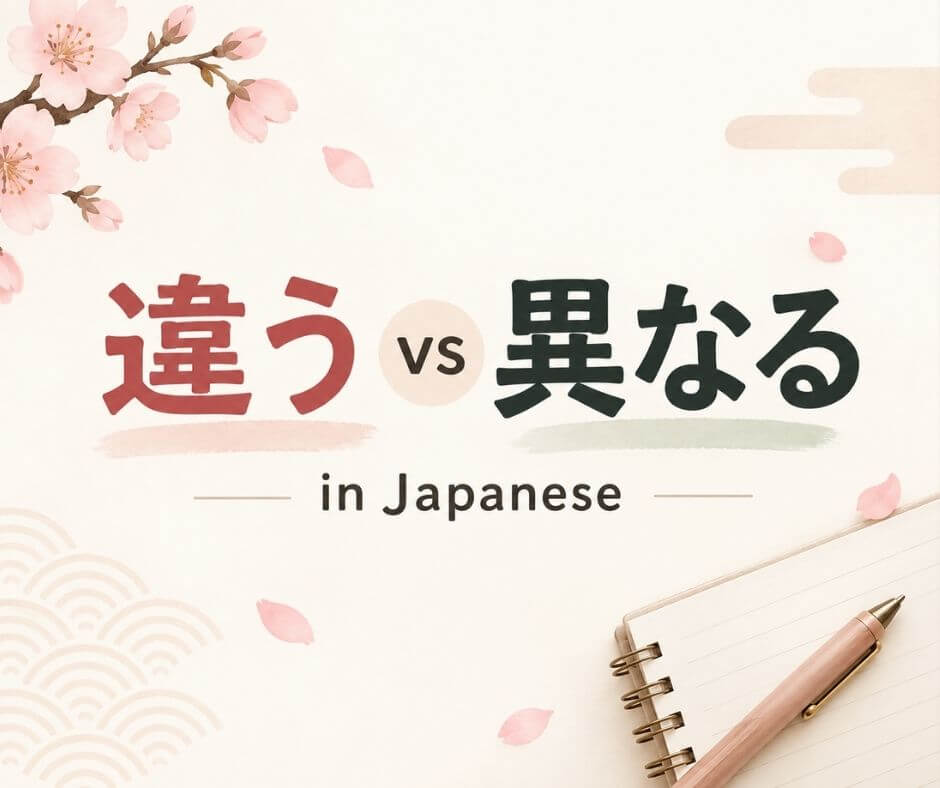
違う or 異なる? How to Say “Different” in Japanese
If you study Japanese, you have probably seen both 違う(ちがう) and 異なる(ことなる).
Both can be translated as “different” or “to differ” in English.
So, what is the difference? 🤔
The easiest way to remember it is:
違う = common and conversational
異なる = formal and written
Let’s look at them more closely! ✨
1. 違う
違(ちが)う is the word you will hear most often in everyday Japanese.
It can mean:
- to be different
- to be incorrect
- to be wrong
- not the same
It is very common in casual conversations. 💬
Example 1
私の考えはあなたの考えと違います。
My opinion is different from yours.
Here, the two opinions are not the same.
Example 2
この二つのバッグは色が違います。
These two bags are different colors.
Example 3
答えが違います。
The answer is wrong.
This is an important point! 💡
違(ちが)う does not always simply mean “different.” It can also mean “wrong” or “incorrect.”
For example:
A: 答えは「東京」ですか?
Is the answer “Tokyo”?
B: いいえ、違います。
No, that’s not correct.
You will hear 違(ちが)います very often in conversations like this.
2. 異なる
異(こと)なる also means “to be different” or “to differ.”
However, it sounds much more formal and objective than 違(ちが)う.
You will often see it in:
- news articles 📰
- reports
- academic writing
- business documents
- official explanations
Example 1
国によって文化が異なります。
Cultures differ depending on the country.
You could also say:
国によって文化が違います。
Cultures are different depending on the country.
Both are correct, but 異(こと)なります sounds more formal.
Example 2
二つの商品の特徴は異なります。
The characteristics of the two products differ.
This sounds like something you might read on a website, brochure, or product comparison.
Example 3
人によって意見が異なる場合があります。
Opinions may differ depending on the person.
Again, 違(ちが)う could also work here, but 異(こと)なる gives the sentence a more formal tone.
違う vs 異なる
The biggest difference is tone and situation. 👀
違う
Use it in everyday conversations.
For example:
この服、昨日のと違うね。
This outfit is different from yesterday’s.
考え方がちょっと違う。
We think a little differently.
それは違うよ!
That’s not right!
These sound very natural in everyday conversation. 👍
異なる
Use it when you want to sound more formal, neutral, or objective.
For example:
地域によってルールが異なります。
The rules differ depending on the region.
それぞれ異なる特徴があります。
Each one has different characteristics.
結果は条件によって異なります。
The results differ depending on the conditions.
You are much more likely to see sentences like these in writing. 📝
Can You Replace 異なる With 違う?
In many cases, yes! ✅
For example:
人によって考え方が違います。
People think differently.
人によって考え方が異なります。
People’s ways of thinking differ.
Both sentences are grammatically correct.
However, the feeling is different.
違(ちが)います sounds natural and conversational.
異(こと)なります sounds more formal and objective.
Imagine talking to your friend:
人によって考え方が異なるね。
People have different ways of thinking.
This is grammatically possible, but it may sound slightly stiff in casual conversation.
In normal conversation, you would probably say:
人によって考え方が違うね。
Everyone thinks differently.
One Important Difference: “Wrong” ⚠️
There is one important situation where you normally cannot replace 違(ちが)う with 異(こと)なる.
That is when 違(ちが)う means “wrong” or “incorrect.”
For example:
その答えは違います。
That answer is wrong.
You would not normally say:
❌ その答えは異なります。
That answer differs.
異(こと)なる simply describes things as being different. It does not normally mean that something is incorrect.
This is one of the most important differences to remember! 💡
Common Expressions With 違う
Here are some useful expressions you will hear in daily Japanese.
何か違う。
Something is different / Something feels off.
何か違う気がする。
I feel like something is off.
全然違う。
Completely different.
写真と実物は全然違いました。
The photo and the real thing were completely different.
違う。
No / That’s not it / That’s wrong.
A: これですか?
Is it this one?
B: 違う、こっち!
No, this one!
These are very common in casual Japanese. 😊
Common Expressions With 異なる
You will often see 異(こと)なる in more formal patterns.
~によって異なる
to differ depending on ~
料金はプランによって異なります。
The price differs depending on the plan.
異なる意見
different opinions
二人は異なる意見を持っています。
The two people have different opinions.
異なる文化
different cultures
異なる文化について学びました。
I learned about different cultures.
Quick Comparison 🔍
違う
Meaning: different / not the same / wrong
Tone: casual and neutral
Common in: everyday conversation
Can mean “wrong”: ✅ Yes
異なる
Meaning: different / to differ
Tone: formal and objective
Common in: writing, news, reports, business
Can mean “wrong”: ❌ Usually no
Easy Way to Remember 💡
Think of it like this:
Talking with friends → 違う
この店、前と違うね。
This restaurant is different from before.
Reading a report → 異なる
地域によって価格が異なります。
Prices differ depending on the region.
If you are not sure which one to use in daily conversation, 違(ちが)う is usually the safest choice. 👍
Final Summary ✨
Both 違(ちが)う and 異(こと)なる can mean “different,” but they are used in slightly different situations.
違(ちが)う is the everyday word. You can use it when talking about things that are different, and it can also mean “wrong” or “incorrect.”
異(こと)なる is more formal and is often used in written Japanese, news, business, and official explanations.
Compare:
この二つは違います。
These two are different.
この二つは異なります。
These two differ.
The meaning is almost the same, but the second sentence sounds more formal.
Mastering small differences like this will help your Japanese sound much more natural!✨
If you want to learn Japanese, improve your skills, or connect with native speakers and other learners, we can help. We offer one-on-one lessons and a supportive community!
Website: nihongonana.com
Email: support@nihongonana.com
✅Private Lesson: NihongoNana Private Lessons
✅Online Community: NihongoNana Community
Recent Posts
-
違う or 異なる? How…
October 6, 2026
-

3 Amazing Bookstores You…
October 5, 2026
-

Say “No” Like a…
October 3, 2026
-

Asian Games 2026: A…
October 2, 2026
-

いい or よい? How…
October 1, 2026
Leave Comment