
 November 11, 2025
 No Comments
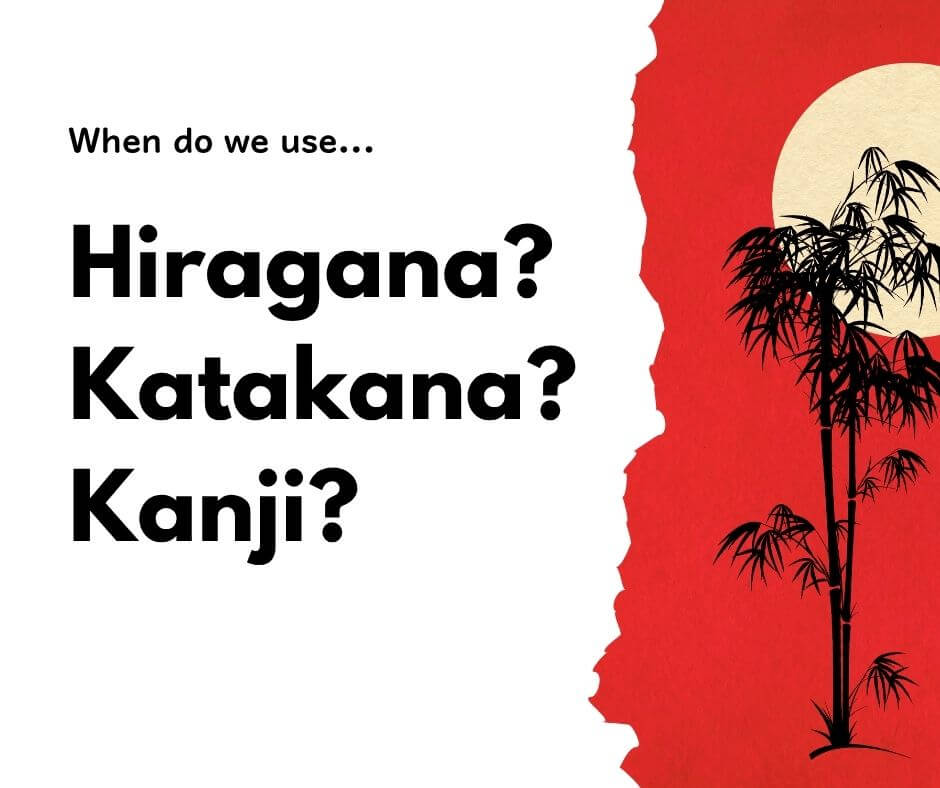
Here is the Difference : Hiragana, Katakana, Kanji
Learning to read and write Japanese can feel confusing at first because Japanese uses three writing systems: Hiragana, Katakana, and Kanji.
Each one has its own purpose and is often used together in the same sentence!
Let’s look at how and when to use each of them.
1. Hiragana (ひらがな)
Hiragana is the foundation of Japanese writing. It’s mainly used for:
- Grammar parts like particles (は, が, を, に) and endings (~ます, ~でした)
- Native Japanese words that don’t have Kanji or whose Kanji is too difficult
- Okurigana — the endings attached to Kanji (like in 食べる or 見ました)
💡 Examples:
猫が 水を 飲んでいます。
(The cat is drinking water.) が・を = particle, んでいます = okurigana
明日 友達 に 会います。
(I will meet my friend tomorrow.) に = particle, います = okurigana
今 おにぎり を 食べています。
(I am eating a rice ball now.) おにぎり = Japanese word, を = particle, べています = okurigana
Hiragana is usually the first script Japanese learners should master.
2. Katakana (カタカナ)
Katakana is used for foreign words, loanwords, and special emphasis (like italics in English). You’ll often see it in non-Japanese names, countries, and onomatope.
It’s used for:
- Foreign words: コーヒー (coffee), コンピューター (computer)
- Foreign names or places: ロンドン (London), アリス (Alice)
- Sound effects (onomatopoeia): ドキドキ (heart beating), ワンワン (dog barking)
- Technical/scientific terms: ウイルス (virus), ロボット (robot)
💡 Examples:
コンビニで コーヒーを 買いました。
(I bought coffee at a convenience store.)
タクシーで ホテルに 行きました。
(I went to the hotel by taxi.)
スーパーで バナナを 買いました。
(I bought bananas at the supermarket.)
If the word sounds like English, it’s probably written in Katakana!
🔴 3. Kanji (漢字)
Kanji are characters borrowed from Chinese and are used to represent meaning rather than sound.
They are used for many types of words like nouns, verbs, adjectives, and Japanese names.
💡 Examples:
学生が 日本へ 行きます。
(A student goes to Japan.)
母は 会社で 働いています。
(My mother works at a company.)
明日 友だちと 映画を 見ます。
(I will watch a movie with my friend tomorrow.)
Each Kanji has more than one reading, so you’ll need to learn the reading in context.
📝 Putting Them Together
In real Japanese writing, all three scripts are mixed together.
💡 Examples:
私は スーパーで パンを 買いました。
(I bought bread at the supermarket.)
先生は コンピューターで 宿題を チェックします。
(The teacher checks homework on the computer.)
私は 東京へ 行きたいです。
(I want to go to Tokyo.)
This mix makes Japanese sentences balanced and natural to read.
🌸 Summary
| Script | Use | Example |
|---|---|---|
| Hiragana | Grammar, native words, okurigana | 食べます, おにぎり, を, は etc |
| Katakana | Foreign words, onomatopoeia, emphasis | コーヒー, ホテル etc |
| Kanji | Nouns, verbs, adjectives, names | 日本, 学生, 行く etc |
✨ Final Tip
Japanese writing may look complicated, but once you know when to use each script, it starts to make sense!
Practice reading short sentences every day, and soon you’ll recognize all three without even thinking about it.
If you want to learn Japanese, improve your skills, or connect with native speakers and other learners, we can help. We offer one-on-one lessons, a supportive community, and on demand courses.
Website: nihongonana.com
Email: support@nihongonana.com
✅Book 1-on-1 lessons: https://nihongonana.com/lessons/
✅Join our Speaking Club: https://nihongonana.com/community/
✅Join our Course Waitlist: https://nihongonana.com/courses/
Recent Posts
-

Ways to Say “Comfortable”…
April 7, 2026
-
フルーツパーク – Unique Tropical…
April 6, 2026
-

有名 vs 人気 Made…
April 4, 2026
-

在宅勤務 – The Truth…
April 3, 2026
-

The Most Confusing Japanese…
April 2, 2026
Leave Comment