
 October 7, 2025
 No Comments
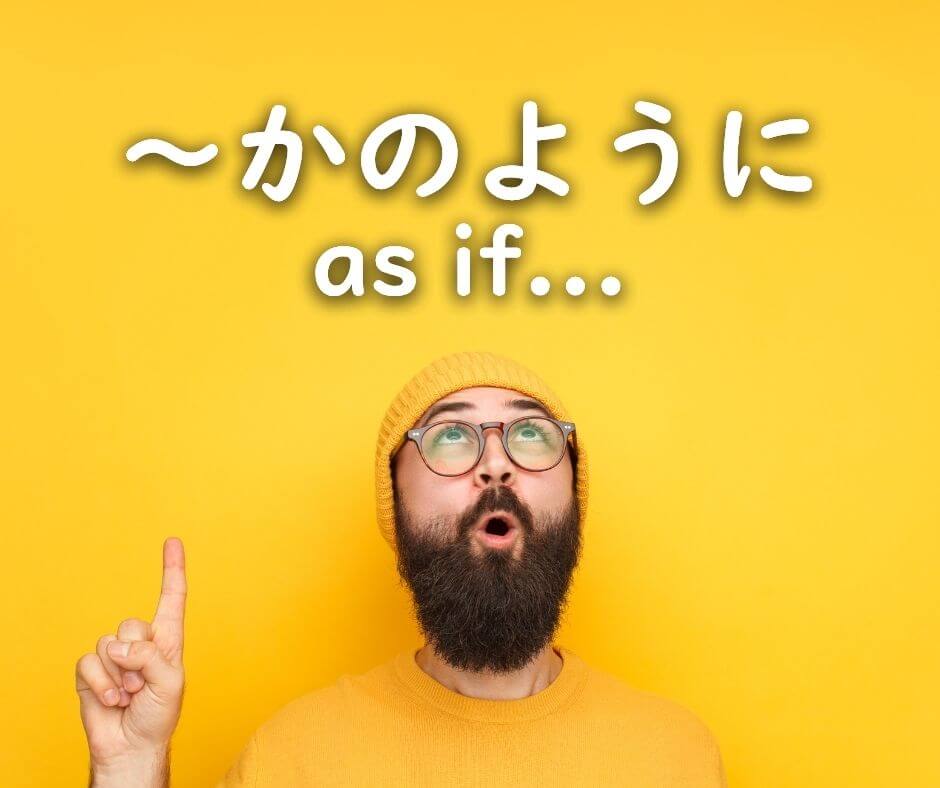
How to Say “As If…” in Japanese: ~かのように
Have you ever wanted to describe something that seems like something else — even though it’s not?
In English, we say things like:
“He talks as if he knows everything.”
“She smiled as if she had won.”
In Japanese, the expression 〜かのように is used to say “as if” or “as though.”
🧩 Structure
Verb (plain form) / Noun + である
い-adj / な-adj + かのように
You can think of it as:
“Like it were ~ / As if it were ~”
| English | Japanese |
|---|---|
| It looks as if he’s crying. | 彼は泣いているかのように見える。 |
| She talks as if she knew everything. | 彼女は全てを知っているかのように話す。 |
| He’s acting as if he were the boss. | 彼は社長であるかのようにふるまう。 |
💡 Meaning and Nuance
This expression adds a dramatic or literary tone to your sentence. It’s often used in writing, novels, or formal speech rather than in casual daily conversation.
For more casual speech, Japanese people often use:
- 〜みたいに
- 〜ように
Compare the tone:
- 彼は泣いているみたい。(conversational)
- 彼は泣いているかのように見える。(formal)
Both mean “It looks like he’s crying,” but かのように sounds more elegant or descriptive.
🧠 Grammar Breakdown
- か = question marker (“whether / if”)
- のように = “like / as”
Together, they form “as if it were like ~.”
✨ More Examples
- 彼は夢の中にいるかのように幸せそうだった。
He looked happy, as if he were in a dream. - 雪が花のように降ってきた。
The snow fell as if it were flowers. - 彼女は何も聞こえないかのように歩き続けた。
She kept walking as if she couldn’t hear anything. - その絵は本物であるかのように見える。
That painting looks as if it were real.
🗣️ Tip for Learners
If you’re writing a story, essay, or trying to sound more expressive in Japanese, 〜かのように is perfect!
But in everyday conversation with friends, use 〜みたいに instead.
📝 Quick Comparison
| Expression | Level | Example | English |
|---|---|---|---|
| ~みたいに | Casual | 泣いているみたい。 | Looks like he’s crying. |
| ~ように | Neutral | 泣いているように見える。 | Seems like he’s crying. |
| ~かのように | Formal / literary | 泣いているかのように見える。 | Looks as if he’s crying. |
🎯 Summary
✅ Use 〜かのように to describe something that appears as if it were true.
✅ It’s formal or literary, not casual.
✅ Works with verbs, adjectives, and nouns (use である for nouns).
🏋️♀️ Exercises
Try completing the sentences using 〜かのように.
その俳優は本当に泣いている____演技した。
(The actor performed as if he were really crying.)
彼は空を飛べる____ジャンプした。
(He jumped as if he could fly.)
彼女は何も知らない____笑っている。
(She’s smiling as if she knows nothing.)
子どもたちは世界が自分のもの____走り回っていた。
(The children ran around as if the world were theirs.)
If you want to learn Japanese, improve your skills, or connect with native speakers and other learners, we can help. We offer one-on-one lessons, a supportive community, and on demand courses.
Website: nihongonana.com
Email: support@nihongonana.com
✅Book 1-on-1 lessons: https://nihongonana.com/lessons/
✅Join our Speaking Club: https://nihongonana.com/community/
✅Join our Course Waitlist: https://nihongonana.com/courses/
Recent Posts
-

Ways to Say “Comfortable”…
April 7, 2026
-

フルーツパーク – Unique Tropical…
April 6, 2026
-

有名 vs 人気 Made…
April 4, 2026
-

在宅勤務 – The Truth…
April 3, 2026
-

The Most Confusing Japanese…
April 2, 2026
Leave Comment