
 October 2, 2025
 No Comments
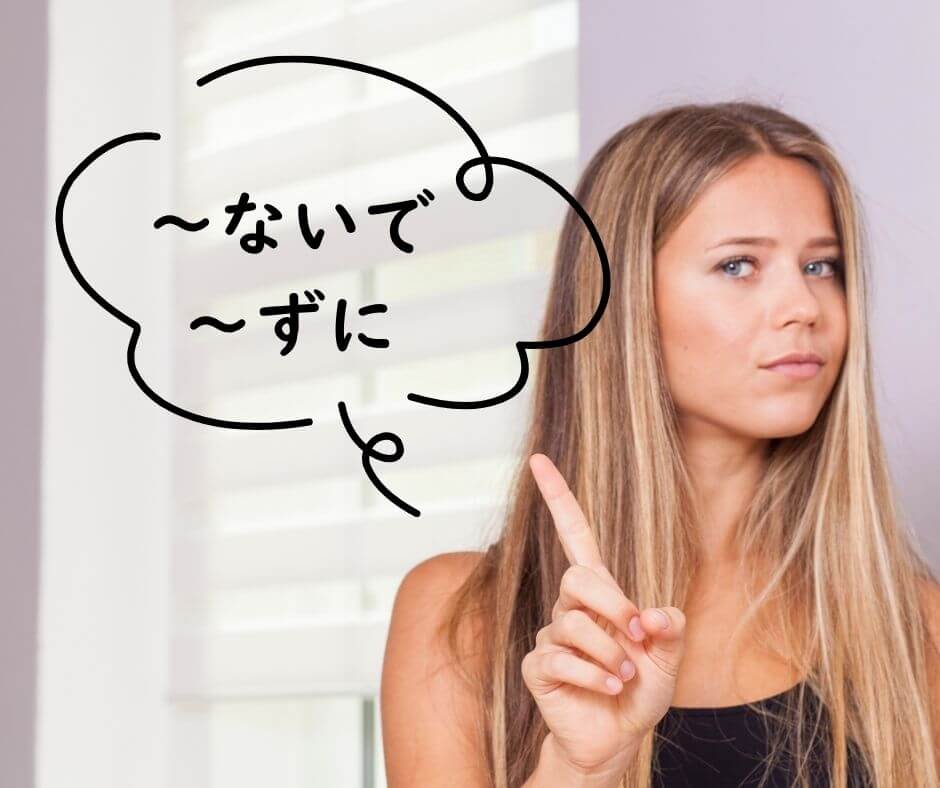
“Without Doing” in Japanese: ~ずに / ~ないで
When you want to say “without doing something” in Japanese, you often use ~ずに or ~ないで. These two grammar points are very similar, but they have slightly different nuances and uses. Let’s break them down! ✨
1. ~ずに: A More Formal Expression 📝
✅ Meaning : Without ~ing
Formation:
- Take the verb in its negative form (ない), drop the ない, and add ずに.
- Exception: する → せずに
Examples:
- 朝ごはんを食べずに学校へ行きました。
(I went to school without eating breakfast.) - 宿題をせずに寝てしまいました。
(I went to bed without doing my homework.)
Usage:
- Common in written language, news articles, and formal speech.
- Sounds a little more polished or literary.
2. ~ないで: The Everyday Way 💬
✅ Meaning : Without ~ing
Formation:
- Simply take the verb in ない-form and add で.
Examples:
- 傘を持たないで出かけました。
(I went out without taking an umbrella.) - 彼は何も言わないで帰りました。
(He left without saying anything.)
Usage:
- Common in spoken Japanese.
- Sounds natural and casual, used in daily conversations.
3. Comparing ~ずに and ~ないで
| Grammar Point | Style & Register | Usage Context | Example |
|---|---|---|---|
| ~ずに | Formal, literary, polite | Written texts, reports, speeches, academic writing | 宿題をせずに寝ました。 (I went to bed without doing homework.) |
| ~ないで | Casual, natural, everyday | Spoken Japanese, conversations, informal writing | 傘を持たないで出かけました。 (I went out without taking an umbrella.) |
💡 Tip: You can usually swap them, but choose based on situation—formal = ~ずに, casual = ~ないで.
4. Useful Example Sentences 📚
- 日本へ行く時、スマホを持たないで行く人はいないと思います。
(When going to Japan, I think nobody goes without taking their smartphone.) - 彼は試験の準備をせずに受けました。
(He took the exam without preparing.) - 音楽を聞かないで勉強するのは難しいです。
(It’s hard to study without listening to music.) - 私はお金を使わずに旅行したいです。
(I want to travel without spending money.)
5. Quick Tips for Learners 🚀
- If you’re writing an essay, report, or formal email → use ~ずに.
- If you’re speaking with friends or in daily conversation → use ~ないで.
- Always remember the exception: する → せずに (not しずに).
✅ Summary:
Both ~ずに and ~ないで express “without doing,” but ~ずに is formal while ~ないで is casual. Mastering these two forms will make your Japanese sound much more natural in both writing and speaking! 🌸e the right one depending on the situation, making your Japanese more accurate and natural.
If you want to learn Japanese, improve your skills, or connect with native speakers and other learners, we can help. We offer one-on-one lessons, a supportive community, and on demand courses.
Website: nihongonana.com
Email: support@nihongonana.com
✅Book 1-on-1 lessons: https://nihongonana.com/lessons/
✅Join our Speaking Club: https://nihongonana.com/community/
✅Join our Course Waitlist: https://nihongonana.com/courses/
Recent Posts
-

在宅勤務 – The Truth…
April 3, 2026
-

The Most Confusing Japanese…
April 2, 2026
-

雑談 – How to…
April 1, 2026
-

年度末 : Busiest Important…
March 31, 2026
-

How to Say “At…
March 30, 2026
Leave Comment