
 September 28, 2026
 No Comments
〜てから vs 〜た後で: Japanese Grammar Made Easy
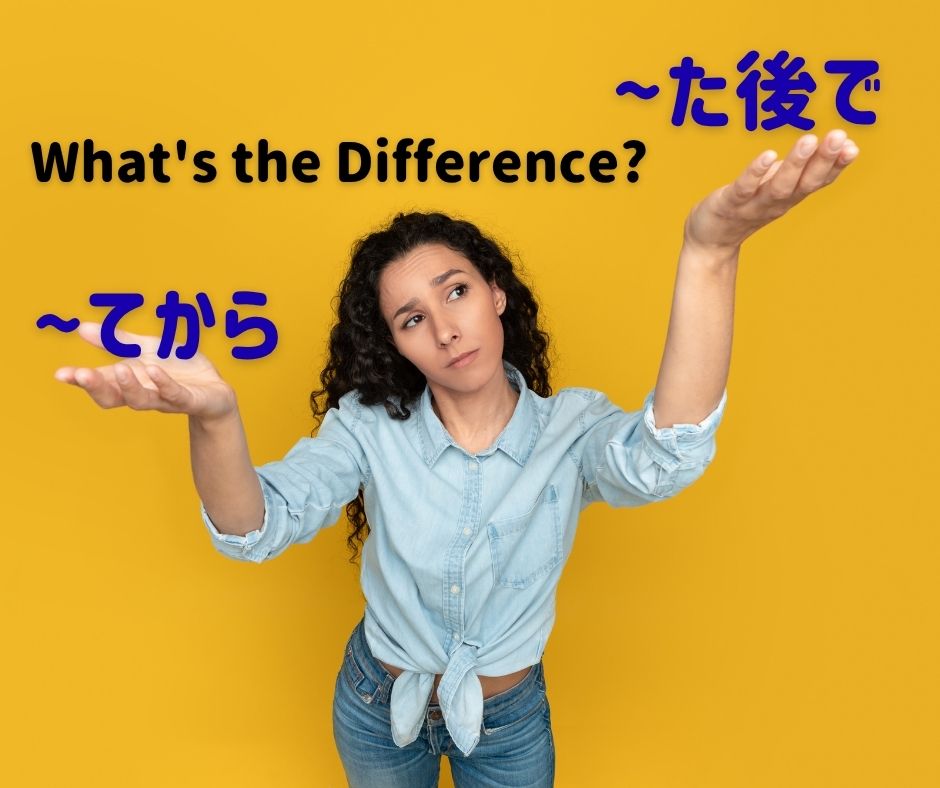
Have you ever wondered about the difference between 〜てから and 〜た後(あと)で?
Both can mean “after doing something”, so they can look very similar. But there is a small difference in how we use them.
Let’s take a look!
① 〜てから
Verb て-form + から
→ after doing ~ / once ~ is done
We use 〜てから when we want to show that one action happens first, and then another action happens after it.
Examples
朝ごはんを食べてから、学校へ行きます。
After eating breakfast, I go to school.
シャワーを浴びてから、寝ます。
I take a shower before going to bed.
日本に来てから、日本語を勉強しています。
I have been studying Japanese since I came to Japan.
In the last example, 〜てから can also mean “since doing ~.”
💡 Key idea
Think of 〜てから as:
A → then B
It emphasizes the sequence: first A, then B.
② 〜た後(あと)で
Verb た-form + 後(あと)で
→ after doing ~
We use 〜た後(あと)で to say that something happens after another action or event.
Examples
朝ごはんを食べた後で、学校へ行きます。
After eating breakfast, I go to school.
仕事が終わった後で、友達とご飯を食べました。
After work finished, I had dinner with my friend.
映画を見た後で、カフェに行きました。
After watching the movie, I went to a café.
You can also use noun + の後(あと)で:
仕事の後で、友達と飲みに行きます。
After work, I’m going out for drinks with my friends.
So, what’s the difference?
In many everyday sentences, 〜てから and 〜た後(あと)で can be interchangeable.
For example:
ご飯を食べてから、勉強します。
After eating, I’ll study.
ご飯を食べた後で、勉強します。
After eating, I’ll study.
Both are natural!
But 〜てから tends to emphasize the order or sequence of actions, while 〜た後(あと)で simply describes something happening after another action or event.
Compare:
薬を飲んでから、寝てください。
Take the medicine first, then go to bed.
→ The sequence is important.
薬を飲んだ後で、少し休みました。
After taking the medicine, I rested for a while.
→ This simply describes what happened afterward.
⚠️ One important difference
〜てから can mean “since ~”, but 〜た後(あと)で cannot.
For example:
日本に来てから、日本語を勉強しています。
I have been studying Japanese since I came to Japan.
You cannot use 〜た後(あと)で here:
❌ 日本に来た後で、日本語を勉強しています。
This sounds like you studied Japanese after coming to Japan as a particular event, rather than emphasizing the period from then until now.
Quick Summary
| Grammar | Meaning | Main idea |
|---|---|---|
| 〜てから | after doing / since doing | Sequence or starting point |
| 〜た後(あと)で | after doing | Something happens afterward |
Easy way to remember:
〜てから → First A, then B
〜た後(あと)で → After A, B happens
Both are useful ways to talk about things that happen in order, so try using them in your everyday Japanese!
A little grammar at a time, and your Japanese will keep getting better! 🇯🇵
If you want to learn Japanese, improve your skills, or connect with native speakers and other learners, we can help. We offer one-on-one lessons and a supportive community!
Website: nihongonana.com
Email: support@nihongonana.com
✅Private Lesson: NihongoNana Private Lessons
✅Online Community: NihongoNana Community
Recent Posts
-

〜てから vs 〜た後で: Japanese…
September 28, 2026
-

3 Popular Factory Tours…
September 26, 2026
-

Japanese Airport Survival Guide:…
September 25, 2026
-

What Is Wagashi? Discover…
September 24, 2026
-

〜たい vs 〜てみたい: The…
September 23, 2026
Leave Comment