

 September 5, 2026
 No Comments
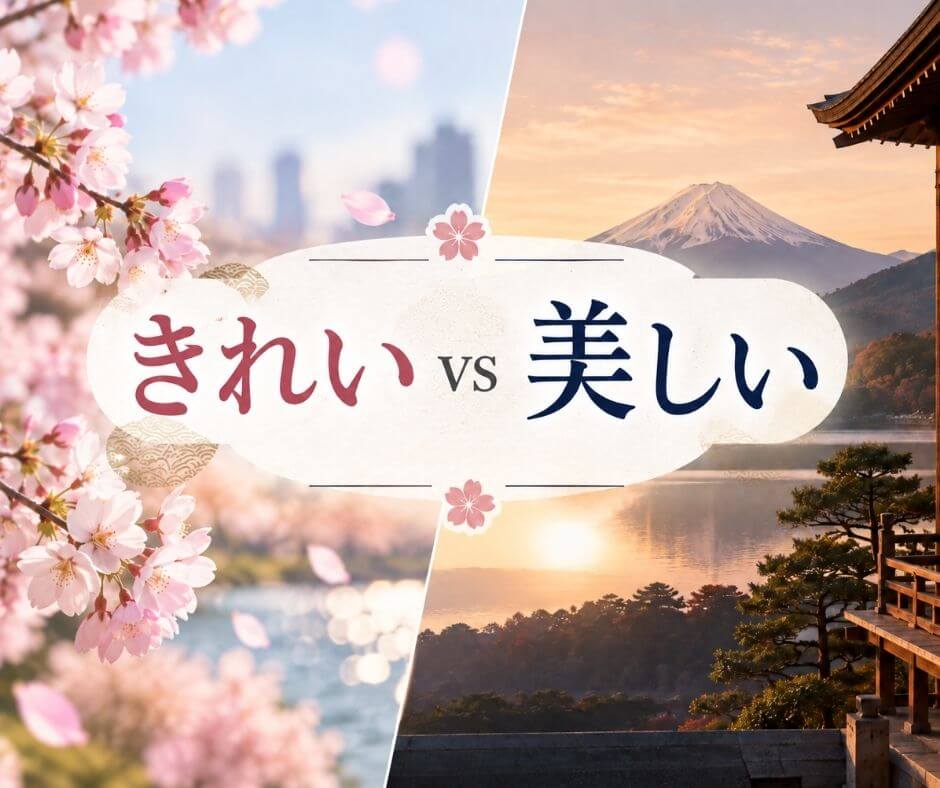
How to Use きれい and 美しい Naturally in Japanese
If you study Japanese, you may notice that both きれい and 美(うつく)しい can mean “beautiful.”
However, Japanese people do not always use them in the same situations.
The biggest difference is that きれい is more common in everyday conversation, while 美(うつく)しい sounds stronger, more elegant, or more literary.
Let’s look at the difference! 😊
きれい — Pretty, Beautiful, or Clean
きれい is a very common word in daily Japanese.
You can use it to describe someone’s appearance, scenery, objects, colors, and many other things.
For example:
この花はきれいですね。
This flower is pretty.
東京の夜景はきれいです。
The night view of Tokyo is beautiful.
彼女はとてもきれいです。
She is very beautiful.
きれい usually sounds casual and natural in conversation.
If you see a nice sunset or a beautiful place, you will often hear Japanese people say:
わあ、きれい!
Wow, beautiful!
きれい Can Also Mean “Clean”
One important point is that きれい does not only mean “beautiful.”
It can also mean clean or tidy.
部屋をきれいにしました。
I cleaned the room.
このホテルはとてもきれいです。
This hotel is very clean.
Because of this, the meaning of きれい depends on the situation.
If someone says:
この部屋はきれいですね。
They are probably saying that the room is clean or tidy, not that the room is “beautiful.”
美しい — Beautiful in a Stronger or More Elegant Way
美(うつく)しい also means “beautiful,” but it often sounds more emotional, elegant, or formal than きれい.
It is commonly used when talking about nature, art, music, writing, or something that feels deeply beautiful.
富士山は美しい山です。
Mt. Fuji is a beautiful mountain.
美しい景色を見ました。
I saw beautiful scenery.
彼女の声はとても美しいです。
Her voice is very beautiful.
You may see 美(うつく)しい more often in books, advertisements, documentaries, speeches, or poetic expressions.
In normal conversation, saying:
この景色、きれい!
sounds more casual and natural than:
この景色は美しいです。
The second sentence is correct, but it sounds more formal or expressive.
Can You Use Both?
Sometimes both words are possible, but the feeling changes slightly.
For example:
きれいな海ですね。
It’s a beautiful sea.
This sounds natural and conversational.
美しい海ですね。
It’s a beautiful sea.
This sounds more poetic or emotionally impressive.
The basic meaning is similar, but 美しい gives the beauty more importance.
What About Describing People?
You can use both words for people, but きれい is much more common in everyday conversation.
あの人、きれいですね。
That person is beautiful.
This sounds natural.
彼女は美しい女性です。
She is a beautiful woman.
This is also correct, but it sounds more formal, elegant, or like something you might read in a story.
Quick Difference
| Word | Meaning | Feeling |
|---|---|---|
| きれい | pretty, beautiful, clean | Casual and common |
| 美しい(うつくしい) | beautiful | Elegant, strong, poetic |
A simple way to remember it is:
Use きれい for everyday “beautiful.”
Use 美(うつく)しい when you want to express deeper, stronger, or more elegant beauty.
Vocabulary
- きれい — pretty / beautiful / clean
- 美しい(うつくしい)— beautiful
- 花(はな)— flower
- 夜景(やけい)— night view
- 部屋(へや)— room
- 景色(けしき)— scenery
- 富士山(ふじさん)— Mt. Fuji
- 海(うみ)— sea
- 声(こえ)— voice
- 女性(じょせい)— woman
Next time you see something beautiful in Japan, try listening carefully. In everyday conversation, you will probably hear きれい! much more often than 美(うつく)しい! 😊
If you want to learn Japanese, improve your skills, or connect with native speakers and other learners, we can help. We offer one-on-one lessons and a supportive community!
Website: nihongonana.com
Email: support@nihongonana.com
✅Private Lesson: NihongoNana Private Lessons
✅Online Community: NihongoNana Community
Recent Posts
-

Japanese School System and…
October 12, 2026
-

6 Beautiful Japanese Phrases…
October 10, 2026
-

The Japanese Custom That…
October 9, 2026
-

How to Say “Maybe”…
October 8, 2026
-

The Fascinating World of…
October 7, 2026
Leave Comment