
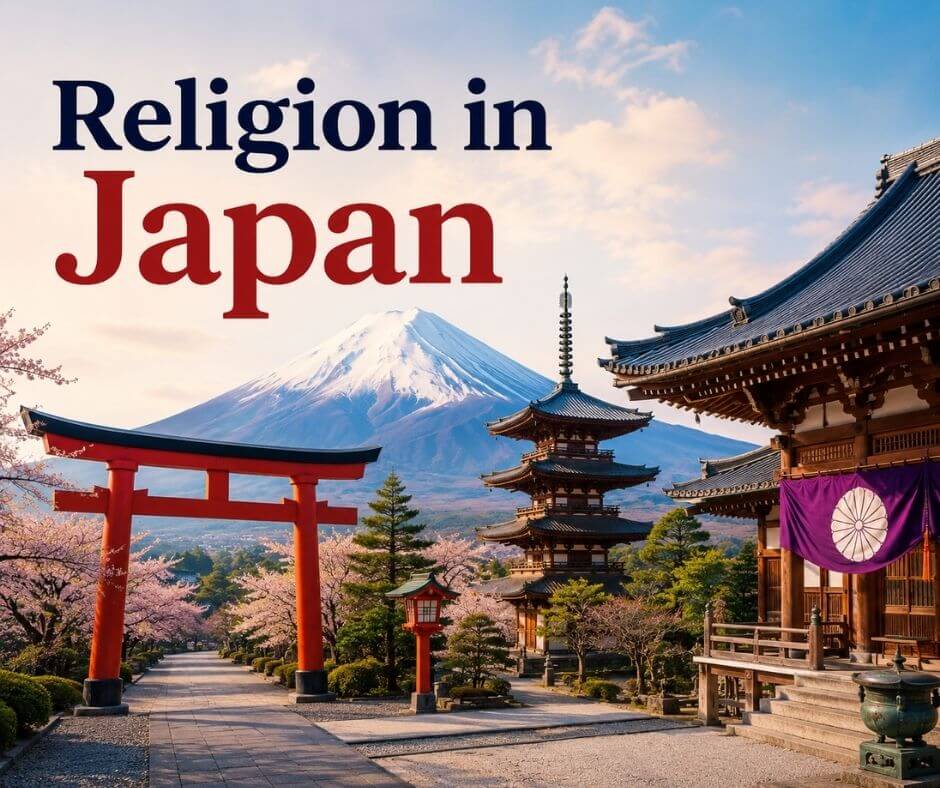
If you visit Japan, you will probably see shrines and temples everywhere. People visit shrines on New Year’s Day, buy lucky charms, pray before important exams, visit family graves during Obon, and have Buddhist funerals.
So, does that mean Japanese people are very religious?
Interestingly, many Japanese people would probably say no.
Religion in Japan works a little differently from how religion is understood in many other countries. A person may say, “I’m not religious,” while still visiting Shinto shrines, participating in Buddhist traditions, and celebrating Christmas.
Let’s take a closer look at religion in Japan and why this apparent contradiction is actually quite normal.
Many Japanese People Say They Are Not Religious
One of the most important things to understand is that many Japanese people do not strongly identify themselves as members of a particular religion.
Surveys have repeatedly found that a large percentage of people in Japan describe themselves as having no particular religious faith. At the same time, participation in Shinto and Buddhist traditions remains very common. Recent research has also found widespread participation in these rituals even among people who identify themselves as nonreligious.
This is because religion is often connected to tradition, family, community, and special occasions rather than being something people consciously practice every day.
Someone might therefore say:
“I’m not religious, but I go to a shrine every New Year.”
To many Japanese people, there is nothing strange about this statement.
Shinto and Buddhism in Japan
The two traditions that have had the biggest influence on Japanese culture are Shinto 神道 (しんとう) and Buddhism 仏教(ぶっきょう).
Shinto is Japan’s indigenous religious tradition. It centers around kami (神 – かみ), spiritual beings or forces associated with nature, places, ancestors, and other parts of life.
You can see Shinto influence in things such as:
- visiting shrines
- praying for good luck
- buying お守(まも)り , or protective charms
- 七五三 (しちごさん) celebrations for children
- traditional festivals called 祭 (まつ)り
Buddhism arrived in Japan from the Asian continent more than a thousand years ago and became deeply connected to Japanese society as well.
Today, Buddhism is especially visible in traditions related to ancestors and death. Buddhist temples commonly hold memorial services, and Buddhist-style funerals remain widespread in Japan.
Can You Be Shinto AND Buddhist?
This is where religion in Japan becomes particularly interesting.
In many cultures, people are expected to belong to one religion. In Japan, however, religious traditions have historically overlapped.
A family might visit a Shinto shrine for New Year, hold a Buddhist funeral, and celebrate Christmas in December.
Nobody necessarily thinks:
“Wait… which religion are we?”
Different traditions are often used for different parts of life.
This overlap even creates an unusual statistical problem. Official religious organizations can report numbers of followers that, when added together, exceed Japan’s total population because the same person may be counted by more than one religious organization.
So trying to answer “What percentage of Japanese people are Shinto?” is not as simple as it might sound.
Religion Is Often More Cultural Than Personal
For many Japanese people, visiting a shrine does not necessarily mean making a strong statement about personal faith.
For example, during 初詣(はつもうで), millions of people visit shrines and temples around New Year.
They might pray for:
- good health
- success at work
- passing an exam
- finding love
- safety
- happiness for their family
Someone may do this every year while still saying that they have no religion.
Similarly, people may visit their ancestors’ graves during お盆(ぼん) because it is an important family tradition rather than because they consciously think of themselves as Buddhist.
Religion, culture, and tradition are therefore difficult to completely separate in Japan.
What About Christmas?
Christmas is another great example.
Japan is not a predominantly Christian country. Christians represent only a small share of the population.
However, Christmas is extremely visible.
You will see Christmas trees, decorations, Christmas music, gifts, special dinners, and Christmas cakes everywhere.
For most people, though, Christmas is not a religious holiday. It is closer to a seasonal celebration.
Younger couples may even treat Christmas Eve as a romantic date night.
Again, Japan is comfortable borrowing traditions without necessarily adopting the religious identity connected to them.
Weddings Can Be Interesting Too
Weddings show the same flexibility.
Some Japanese couples have traditional Shinto wedding ceremonies.
Others choose Western-style weddings with white dresses, chapels, rings, and a ceremony that looks Christian—even when the couple themselves are not Christian.
The style of ceremony can simply be based on personal preference.
This flexibility is one of the most fascinating characteristics of religion in modern Japan.
Why Do People Say “I’m Not Religious”?
The Japanese word for religion is:
宗教 (しゅうきょう)
However, saying that someone is “religious” can sometimes sound stronger in Japanese than it does in English.
For some people, 宗教(しゅうきょう) brings to mind membership in a specific religious organization or having strong religious beliefs.
Because of this, someone who casually visits shrines, celebrates Buddhist traditions, and believes vaguely in spirits or good luck may still say:
宗教(しゅうきょう)は特(とく)にないです。
I don’t have any particular religion.
Rather than saying Japanese people simply “do not believe in religion,” it may be more accurate to say that religious identity and religious practice do not always match.
So, Are Japanese People Religious?
The answer is:
It depends on what you mean by “religious.”
If being religious means strongly identifying with one faith and regularly following its teachings, many Japanese people would probably not describe themselves that way.
But if religion includes visiting shrines, honoring ancestors, praying for good luck, participating in festivals, carrying lucky charms, and following traditions connected to Shinto and Buddhism, religion is still deeply present in everyday Japanese culture.
That is what makes religion in Japan so interesting.
A person can visit a shrine, have a Buddhist funeral, celebrate Christmas, and still comfortably say:
“I’m not religious.”
Rather than being contradictory, in Japan, that can be completely normal.