
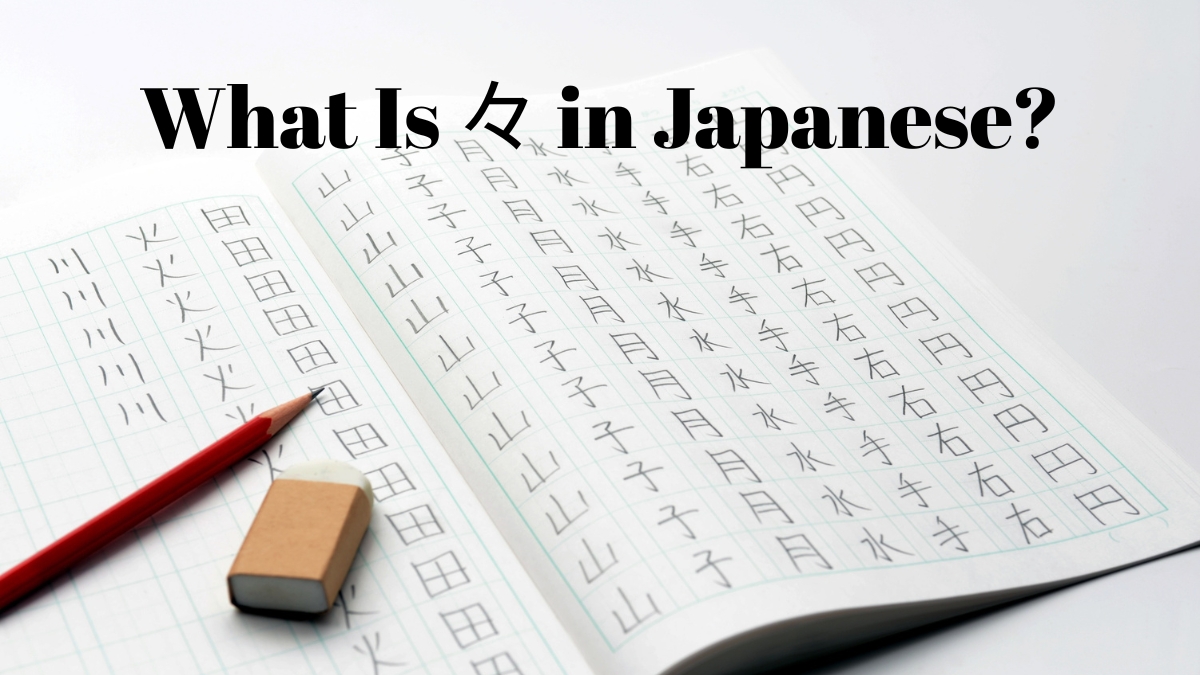
What is 々 in Japanese? This small symbol means “repeat the kanji immediately before it.” It is called a kanji iteration mark. For example, 時々 represents 時 + 時 and is read ときどき (tokidoki), meaning “sometimes.”
You may have seen 々 in words such as 人々, 色々, or a name like 佐々木. It looks like it could be another kanji, but it is a repetition symbol. In this guide, you’ll learn how to recognize it, read common words, and type it yourself.
Level: Beginner-friendly (N5–N4 learners). Some examples are extra vocabulary. This is a reading guide, not an official JLPT vocabulary list.
Reading tip: Use the Furigana switch above to turn the readings over kanji on or off.
々 in Japanese at a Glance
| Word | Reading | Meaning |
|---|---|---|
| 時々 | tokidoki | sometimes |
| 人々 | hitobito | people |
| 日々 | hibi | days; day by day |
| 色々 | iroiro | various |
| 少々 | shōshō | a little |
| 段々 | dandan | gradually |
1. What Does 々 Mean?
Think of 々 as a written shortcut: use the same kanji again. In 人々, it stands for another 人. In 時々, it stands for another 時. It repeats the written character, but the pronunciation may change inside the word.
Its Japanese names include 同の字点 (どうのじてん, dō no jiten) and the informal nickname ノマ (noma), because its shape resembles ノ and マ. It belongs to a family of repetition marks called 踊り字 (おどりじ, odoriji).
The National Institute for Japanese Language and Linguistics explains that these marks repeat characters and have no independent sound or meaning of their own. See its explanation of Japanese iteration marks.
2. How Do You Pronounce 々?
々 has no single pronunciation. Read the whole word. You do not say “noma” every time you meet the symbol in a sentence; that is a name for the mark.
Sometimes the second part changes sound through rendaku, or sequential voicing. For example, とき + とき becomes ときどき, and ひと + ひと becomes ひとびと. But this does not happen in every word: 色々 is いろいろ.
Learn the word and its reading together. The mark tells you which kanji is repeated; it does not tell you exactly how the full word sounds.
3. Common Words with 々 and Example Sentences
時々 — sometimes
Use it to talk about something you do occasionally.
時々、日本の映画を見ます。
→ I sometimes watch Japanese movies.
人々 — people
This refers to people collectively. It is common in descriptions, news, and writing.
この町の人々は親切です。
→ The people in this town are kind.
日々 — days; day by day
This often appears when describing daily life or gradual change. For a simple “every day,” 毎日 is another useful word.
日々、新しいことを学んでいます。
→ I’m learning new things day by day.
色々 — various; all kinds of
You will also often see it written entirely in hiragana: いろいろ. Before a noun, use いろいろな.
色々な食べ物を食べてみたいです。
→ I want to try various foods.
少々 — a little
This is especially useful to recognize in polite service language.
少々お待ちください。
→ Please wait a moment.
段々 — gradually
The hiragana spelling だんだん is also common.
段々寒くなってきました。
→ It has gradually been getting colder.
4. Does 々 Make a Word Plural?
No—not automatically. 人々 means “people,” and 山々 (やまやま, yamayama) can mean “mountains,” so repetition sometimes expresses a group or multiplicity. But 時々 means “sometimes,” and 少々 means “a little.”
Treat these as established words. You cannot add 々 to any kanji to make a plural, and Japanese nouns do not generally require a plural ending. For example, 本 (ほん) can mean “a book” or “books,” depending on context.
5. Why Is 々 Used in Japanese Names?
The same mark appears in names such as 佐々木 (Sasaki) and 代々木 (Yoyogi), a place name in Tokyo. In 佐々木, the mark repeats 佐; it does not repeat the whole name.
Names have their own established readings. Recognizing 々 helps you understand the spelling, but you should still check how a person reads their name.
6. How to Type 々
A practical method with a Japanese keyboard or input method is to type ときどき, convert it to 時々, and delete 時 if you need only the symbol.
Some input methods also offer 々 when you convert おなじ, くりかえし, or どう. Available candidates depend on your device and keyboard. You can also copy it here: 々.
Common Mistakes to Avoid
Reading 々 as “noma” inside a word. Read 時々 as ときどき, not “toki-noma.”
Repeating exactly the same sound every time. 人々 is ひとびと, not ひとひと. Learn each word’s pronunciation.
Using it whenever two matching kanji touch. Word boundaries matter. For example, 民主主義 (“democracy”): the two 主 belong to different parts, so do not replace the second one with 々.
Confusing 々 with ヽ or ゝ. Those are kana repetition marks. For everyday kanji vocabulary, the mark to recognize is 々.
Mini Quiz: Can You Read These Words?
1. How do you read 時々?
A. ときとき B. ときどき
2. What does 々 represent in 人々?
A. Another 人 B. A fixed “noma” sound
3. Does 々 always make a word plural?
A. Yes B. No
4. Which reading matches 色々?
A. いろいろ B. いろびろ
Answers: 1 B, 2 A, 3 B, 4 A.
々 repeats the previous kanji. The complete word determines both the reading and the meaning.
Frequently Asked Questions
Is 々 a kanji?
No. It is a repetition mark used with kanji. It has no independent word meaning or fixed reading.
What is 々 called in English?
It is usually called a “kanji iteration mark.” “Kanji repetition mark” is another clear description.
Can I write the kanji twice instead?
The mark represents a repeated kanji, but conventional spelling matters. Use the usual forms, such as 時々 and 人々, and preserve the official spelling of names.
Is 々 the same as a ditto mark?
The idea is similar, but 々 normally repeats the preceding kanji within a word or name. It is not a general instruction to repeat any previous line or phrase.
Try Reading 々 Today
Start with three words: 時々, 人々, and 色々. Turn off the furigana and read them aloud. Next time you spot 々, look at the kanji immediately before it, then check the reading of the whole word.
Want to use the food example above? Continue with our guide to saying “try” in Japanese. For speaking practice with a teacher, explore NihongoNana’s Japanese lessons.