
 September 15, 2026
 No Comments
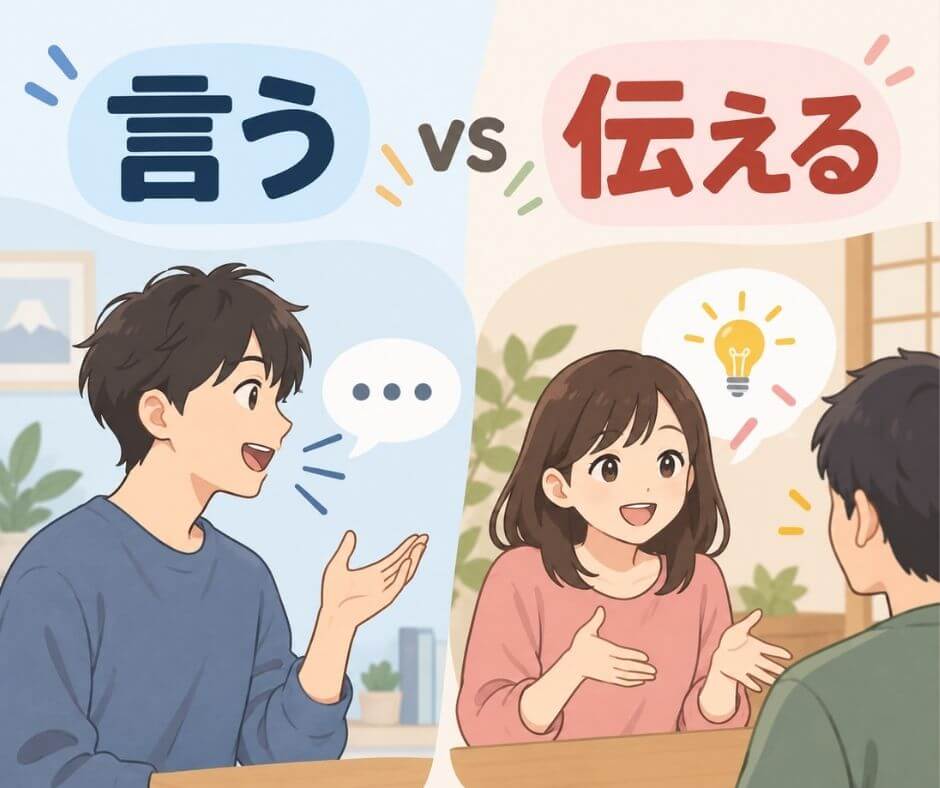
Difference Between 言う and 伝える in Japanese
The Japanese verbs 言(い)う and 伝(つた)える can both be translated as “to say” or “to tell” in English.
However, they are not exactly the same 🤔
The main difference is very simple:
🗣️ 言う = to say something
💬 伝える = to communicate / pass information to someone
Let’s look at the difference! 😊
🗣️ 言う: To Say
言(い)う focuses on the words that someone says.
It is used when you simply want to describe what someone said.
Example
「ありがとう」と言いました。
I said, “Thank you.”
Here, we are focusing on the actual words: ありがとう.
Another example:
先生は「宿題があります」と言いました。
The teacher said, “There is homework.”
We are simply reporting what the teacher said 📢
Pattern
「 」と言う
This pattern is very common when quoting someone.
For example:
彼は「疲れた」と言いました。
He said, “I’m tired.”
母は「早く寝て」と言いました。
My mother said, “Go to bed early.”
So, when you want to talk about the words someone said, 言(い)う is usually the natural choice 👍
💬 伝える: To Tell / Communicate
伝(つた)える focuses more on getting information, a message, or a feeling to another person.
The important point is not the exact words. The important point is that the information reaches someone 📩
Example
先生に予定を伝えました。
I told the teacher my schedule.
Here, you are communicating information about your schedule to the teacher.
Another example:
みんなにニュースを伝えました。
I told everyone the news.
The focus is on passing the information to other people.
Common Things We 伝える
You can use 伝(つた)える with things such as:
❤️ 気持ち — feelings
📰 ニュース — news
💌 メッセージ — message
📅 予定 — schedule / plans
ℹ️ 情報 — information
💡 理由 — reason
For example:
自分の気持ちを伝えました。
I told them how I felt.
大切な情報を伝えました。
I communicated important information.
⚖️ 言う vs 伝える
Compare these two sentences:
田中さんは「明日は休みです」と言いました。
Tanaka-san said, “Tomorrow is a day off.”
Here, we are focusing on what Tanaka-san said.
Now:
田中さんはみんなに明日は休みだと伝えました。
Tanaka-san told everyone that tomorrow was a day off.
Here, we are focusing on communicating that information to everyone.
The basic idea is:
🗣️ 言(い)う → What did someone say?
📩 伝(つた)える → What information did someone communicate?
🎉 Another Example
Imagine you want your friend to tell Yuki that the party starts at 7:00.
You could say:
ゆきさんに「パーティーは7時からです」と言ってください。
Please say to Yuki, “The party starts at 7.”
This focuses more on the actual words.
But you could also say:
ゆきさんにパーティーは7時からだと伝えてください。
Please tell Yuki that the party starts at 7.
This focuses on making sure Yuki receives the information 📩
In this situation, 伝(つた)えてください sounds very natural because you are asking someone to pass on a message.
🙌 A Very Common Expression
You may also hear:
よろしくお伝えください。
Please give them my regards.
This expression uses 伝(つた)える because you are asking someone to pass your message or feelings to another person.
For example:
田中さんによろしくお伝えください。
Please give Tanaka-san my regards.
🤔 Can You Use Both?
Sometimes both 言(い)う and 伝(つた)える are grammatically possible, but the nuance changes.
For example:
彼に好きだと言いました。
I said to him, “I like you.”
This focuses on the fact that you said the words.
彼に好きだと伝えました。
I told him that I liked him.
This has a stronger feeling of communicating your feelings to him ❤️
So when talking about feelings, 伝(つた)える often sounds more intentional.
📊 Quick Comparison
| 言(い)う | 伝(つた)える |
|---|---|
| 🗣️ to say | 💬 to tell / communicate |
| Focuses on words | Focuses on information or a message |
| What did someone say? | What did someone communicate? |
| Often used with quotes | Often used with a person receiving information |
| 「ありがとう」と言(い)う | 気持(きも)ちを伝(つた)える |
🧠 Easy Way to Remember
Think of it like this:
🗣️ 言(い)う = words come out of your mouth
📩 伝(つた)える = a message reaches another person
For example:
「ありがとう」と言う。
Say “thank you.”
感謝の気持ちを伝える。
Express your feelings of gratitude.
Both involve communication, but the focus is different ✨
✅ Summary
言(い)う means “to say” and focuses on the words someone says.
伝(つた)える means “to tell,” “communicate,” or “convey” and focuses on passing information, a message, or feelings to another person.
Compare:
「また明日」と言いました。
I said, “See you tomorrow.”
明日の予定を伝えました。
I told them tomorrow’s schedule.
If you remember 言(い)う = words 🗣️ and 伝(つた)える = message 📩, choosing between them will become much easier! 😊
If you want to learn Japanese, improve your skills, or connect with native speakers and other learners, we can help. We offer one-on-one lessons and a supportive community!
Website: nihongonana.com
Email: support@nihongonana.com
✅Private Lesson: NihongoNana Private Lessons
✅Online Community: NihongoNana Community
Recent Posts
-

Difference Between 言う and…
September 15, 2026
-

A Beautiful Day in…
September 14, 2026
-

How to Say “Probably”…
September 13, 2026
-

Japanese Spider Lily: A…
September 11, 2026
-

Difference Between 思う and…
September 10, 2026
Leave Comment