

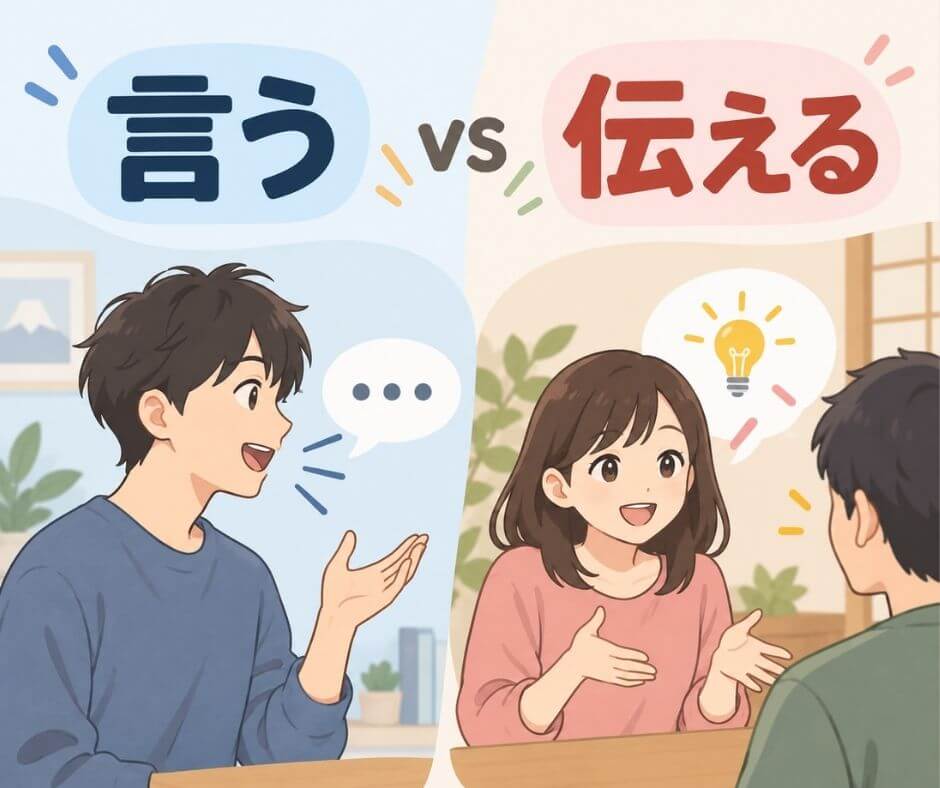
The Japanese verbs 言(い)う and 伝(つた)える can both be translated as “to say” or “to tell” in English.
However, they are not exactly the same 🤔
The main difference is very simple:
🗣️ 言う = to say something
💬 伝える = to communicate / pass information to someone
Let’s look at the difference! 😊
🗣️ 言う: To Say
言(い)う focuses on the words that someone says.
It is used when you simply want to describe what someone said.
Example
「ありがとう」と言いました。
I said, “Thank you.”
Here, we are focusing on the actual words: ありがとう.
Another example:
先生は「宿題があります」と言いました。
The teacher said, “There is homework.”
We are simply reporting what the teacher said 📢
Pattern
「 」と言う
This pattern is very common when quoting someone.
For example:
彼は「疲れた」と言いました。
He said, “I’m tired.”
母は「早く寝て」と言いました。
My mother said, “Go to bed early.”
So, when you want to talk about the words someone said, 言(い)う is usually the natural choice 👍
💬 伝える: To Tell / Communicate
伝(つた)える focuses more on getting information, a message, or a feeling to another person.
The important point is not the exact words. The important point is that the information reaches someone 📩
Example
先生に予定を伝えました。
I told the teacher my schedule.
Here, you are communicating information about your schedule to the teacher.
Another example:
みんなにニュースを伝えました。
I told everyone the news.
The focus is on passing the information to other people.
Common Things We 伝える
You can use 伝(つた)える with things such as:
❤️ 気持ち — feelings
📰 ニュース — news
💌 メッセージ — message
📅 予定 — schedule / plans
ℹ️ 情報 — information
💡 理由 — reason
For example:
自分の気持ちを伝えました。
I told them how I felt.
大切な情報を伝えました。
I communicated important information.
⚖️ 言う vs 伝える
Compare these two sentences:
田中さんは「明日は休みです」と言いました。
Tanaka-san said, “Tomorrow is a day off.”
Here, we are focusing on what Tanaka-san said.
Now:
田中さんはみんなに明日は休みだと伝えました。
Tanaka-san told everyone that tomorrow was a day off.
Here, we are focusing on communicating that information to everyone.
The basic idea is:
🗣️ 言(い)う → What did someone say?
📩 伝(つた)える → What information did someone communicate?
🎉 Another Example
Imagine you want your friend to tell Yuki that the party starts at 7:00.
You could say:
ゆきさんに「パーティーは7時からです」と言ってください。
Please say to Yuki, “The party starts at 7.”
This focuses more on the actual words.
But you could also say:
ゆきさんにパーティーは7時からだと伝えてください。
Please tell Yuki that the party starts at 7.
This focuses on making sure Yuki receives the information 📩
In this situation, 伝(つた)えてください sounds very natural because you are asking someone to pass on a message.
🙌 A Very Common Expression
You may also hear:
よろしくお伝えください。
Please give them my regards.
This expression uses 伝(つた)える because you are asking someone to pass your message or feelings to another person.
For example:
田中さんによろしくお伝えください。
Please give Tanaka-san my regards.
🤔 Can You Use Both?
Sometimes both 言(い)う and 伝(つた)える are grammatically possible, but the nuance changes.
For example:
彼に好きだと言いました。
I said to him, “I like you.”
This focuses on the fact that you said the words.
彼に好きだと伝えました。
I told him that I liked him.
This has a stronger feeling of communicating your feelings to him ❤️
So when talking about feelings, 伝(つた)える often sounds more intentional.
📊 Quick Comparison
| 言(い)う | 伝(つた)える |
|---|---|
| 🗣️ to say | 💬 to tell / communicate |
| Focuses on words | Focuses on information or a message |
| What did someone say? | What did someone communicate? |
| Often used with quotes | Often used with a person receiving information |
| 「ありがとう」と言(い)う | 気持(きも)ちを伝(つた)える |
🧠 Easy Way to Remember
Think of it like this:
🗣️ 言(い)う = words come out of your mouth
📩 伝(つた)える = a message reaches another person
For example:
「ありがとう」と言う。
Say “thank you.”
感謝の気持ちを伝える。
Express your feelings of gratitude.
Both involve communication, but the focus is different ✨
✅ Summary
言(い)う means “to say” and focuses on the words someone says.
伝(つた)える means “to tell,” “communicate,” or “convey” and focuses on passing information, a message, or feelings to another person.
Compare:
「また明日」と言いました。
I said, “See you tomorrow.”
明日の予定を伝えました。
I told them tomorrow’s schedule.
If you remember 言(い)う = words 🗣️ and 伝(つた)える = message 📩, choosing between them will become much easier! 😊