

 August 6, 2026
 No Comments
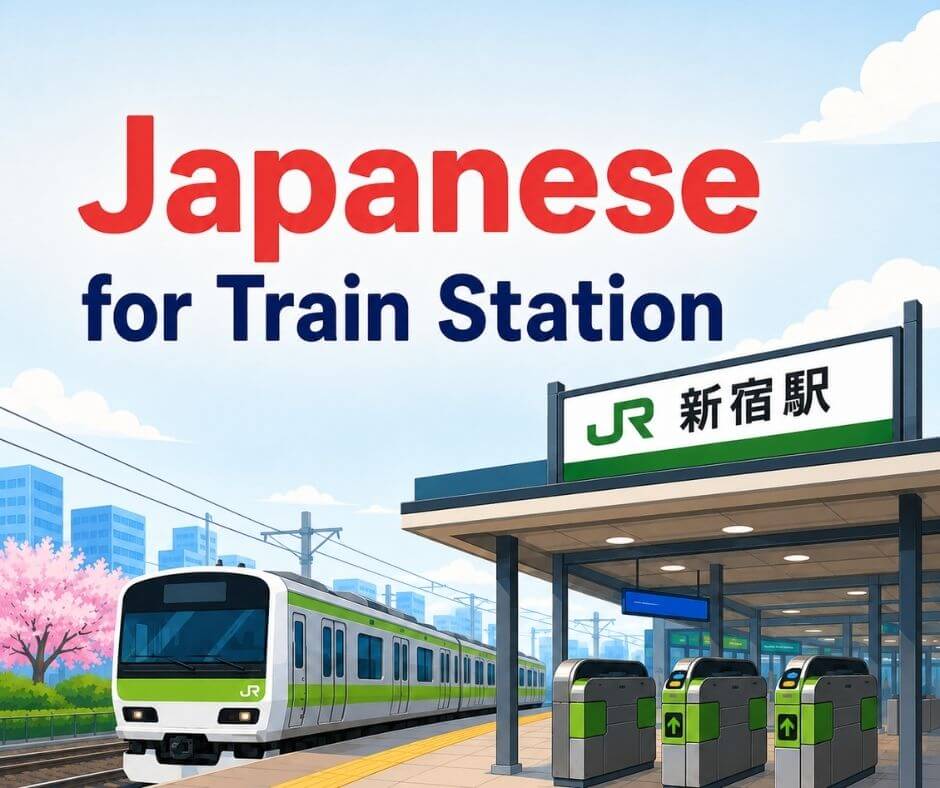
Easy Japanese for Train Stations Every Traveler Should Know
Japan’s train system is convenient, safe, and efficient, but large stations can feel confusing—especially when you cannot read all the signs or understand the announcements.
Knowing a few simple Japanese phrases can make traveling much easier. In this guide, you will learn useful Japanese for buying tickets, asking for directions, finding platforms, and handling common problems at train stations.
1. Where Is the Train Station?
駅はどこですか。
Where is the train station?
This is useful when you are walking around a city and cannot find the nearest station.
You can also ask for a specific station:
新宿駅はどこですか。
Where is Shinjuku Station?
駅(えき) means “station.” When a station name comes before 駅(えき), it becomes part of the station’s name.
2. Where Is the Ticket Machine?
券売機はどこですか。
Where is the ticket machine?
券売機(けんばいき) means “ticket machine.” Most stations have automatic machines where you can buy regular train tickets or recharge an IC card.
Another useful word is:
切符
Train ticket
For example:
切符を買いたいです。
I would like to buy a ticket.
3. How Much Is It to This Station?
東京駅までいくらですか。
How much is it to Tokyo Station?
まで means “to” or “as far as.”
You can replace 東京駅(とうきょうえき) with any destination:
京都駅までいくらですか。
How much is it to Kyoto Station?
4. One Ticket, Please
切符を一枚お願いします。
One ticket, please.
Japanese uses counters when counting objects. 枚 is the counter used for flat objects such as tickets, paper, and cards.
One ticket:
一枚
Two tickets:
二枚
For example:
大阪まで切符を二枚お願いします。
Two tickets to Osaka, please.
5. Can I Use an IC Card?
ICカードは使えますか。
Can I use an IC card?
IC cards such as Suica, PASMO, and ICOCA can be used on many trains, buses, and at some shops.
You may also need to recharge your card:
チャージはどこでできますか。
Where can I recharge my card?
In Japanese, adding money to an IC card is commonly called チャージ.
6. Where Is the Ticket Gate?
改札はどこですか。
Where is the ticket gate?
改札(かいさつ) refers to the entrance and exit gates where you tap your IC card or insert your ticket.
Large stations may have several ticket gates, so check the name of the gate carefully.
For example:
中央改札はどこですか。
Where is the central ticket gate?
7. Which Platform Should I Use?
何番線ですか。
Which platform is it?
Japanese train platforms are usually numbered.
You can ask:
渋谷に行く電車は何番線ですか。
Which platform is the train to Shibuya?
電車(でんしゃ) means “train,” and 行(い)く means “to go.”
A station employee may answer:
三番線です。
It is platform three.
8. Does This Train Go to My Destination?
この電車は横浜に行きますか。
Does this train go to Yokohama?
This is one of the most useful phrases when you are unsure whether you are waiting for the correct train.
You can also ask:
これは新宿行きですか。
Is this train bound for Shinjuku?
行(い)き means “bound for” when it follows the name of a destination.
9. Is This a Local or Express Train?
これは各駅停車ですか。
Is this a local train?
各駅停車(かくえきていしゃ) is a train that stops at every station.
これは急行ですか。
Is this an express train?
Express trains skip some stations, so always check whether the train stops at your destination.
You can ask:
この電車は〇〇駅に止まりますか。
Does this train stop at 〇〇 Station?
10. Where Do I Transfer?
どこで乗り換えますか。
Where do I transfer?
乗(の)り換(か)える means “to transfer” or “to change trains.”
For example:
東京駅に行きたいです。どこで乗り換えますか。
I would like to go to Tokyo Station. Where do I transfer?
You may hear an answer such as:
新宿駅で乗り換えてください。
Please transfer at Shinjuku Station.
11. I Think I Took the Wrong Train
電車を間違えました。
I took the wrong train.
間違(まちが)える means “to make a mistake” or “to choose the wrong thing.”
You can explain your destination:
京都駅に行きたいです。
I want to go to Kyoto Station.
どうすればいいですか。
What should I do?
Together, you can say:
電車を間違えました。京都駅に行きたいです。どうすればいいですか。
I took the wrong train. I want to go to Kyoto Station. What should I do?
12. My Ticket Is Not Working
切符が使えません。
My ticket is not working.
ICカードが使えません。
My IC card is not working.
At many stations, there is a station employee near the ticket gates who can help you.
You can also say:
すみません、助けてください。
Excuse me, please help me.
13. I Lost My Ticket
切符をなくしました。
I lost my ticket.
If you lose your ticket, speak to a station employee before trying to leave the station.
You may be asked where you started your journey:
どこから乗りましたか。
Where did you get on the train?
You can answer:
新宿駅から乗りました。
I got on at Shinjuku Station.
14. Where Is the Exit?
出口はどこですか。
Where is the exit?
Large stations often have many exits, so it is helpful to know the name or number of the exit you need.
東口はどこですか。
Where is the east exit?
西口はどこですか。
Where is the west exit?
北口はどこですか。
Where is the north exit?
南口はどこですか。
Where is the south exit?
You may also see numbered exits such as A1, B2, or Exit 5.
15. Is There an Elevator?
エレベーターはありますか。
Is there an elevator?
This is useful when you have large luggage, a stroller, or difficulty using stairs.
You can also ask:
エレベーターはどこですか。
Where is the elevator?
コインロッカーはありますか。
Are there coin lockers?
Coin lockers are available at many major train stations and can be useful when traveling with luggage.
Useful Train Station Vocabulary
駅(えき)– station
電車(でんしゃ)– train
切符(きっぷ)– ticket
券売機(けんばいき)– ticket machine
改札(かいさつ)– ticket gate
ホーム – platform
番線(ばんせん)– platform number
出口(でぐち)– exit
入口(いりぐち)– entrance
乗り換え(のりかえ)– transfer
各駅停車(かくえきていしゃ)– local train
急行(きゅうこう)– express train
快速(かいそく)– rapid train
始発(しはつ)– first train
終電(しゅうでん)– last train
片道(かたみち)– one way
往復(おうふく)– round trip
遅延(ちえん)– delay
駅員(えきいん)– station employee
忘れ物(わすれもの)– lost property
Example Conversation at a Train Station
Traveler:
すみません。東京駅に行きたいです。
Excuse me. I would like to go to Tokyo Station.
Station employee:
この電車に乗ってください。
Please take this train.
Traveler:
乗り換えはありますか。
Do I need to transfer?
Station employee:
はい、新宿駅で乗り換えてください。
Yes, please transfer at Shinjuku Station.
Traveler:
何番線ですか。
Which platform is it?
Station employee:
四番線です。
It is platform four.
Traveler:
ありがとうございます。
Thank you very much.
Quick Travel Tips
When asking for help, show the station name on your phone. This makes communication easier even when pronunciation is difficult.
Listen carefully for words such as 各駅停車(かくえきていしゃ), 急行(きゅうこう), and 快速(かいそく) because different trains may stop at different stations.
At busy stations, stand to the side before checking your phone or luggage so you do not block other passengers.
Finally, do not worry about speaking perfect Japanese. A simple phrase such as すみません followed by your destination is often enough to start a helpful conversation.
Final Summary
You do not need advanced Japanese to travel by train in Japan. Learning a few phrases for tickets, platforms, transfers, and exits can make your journey much smoother.
Start by remembering these five essential phrases:
駅はどこですか。
Where is the station?
何番線ですか。
Which platform is it?
この電車は〇〇に行きますか。
Does this train go to 〇〇?
どこで乗り換えますか。
Where do I transfer?
出口はどこですか。
Where is the exit?
Practice these expressions before your trip, and you will feel much more confident using Japanese trains.
If you want to learn Japanese, improve your skills, or connect with native speakers and other learners, we can help. We offer one-on-one lessons and a supportive community!
Website: nihongonana.com
Email: support@nihongonana.com
✅Private Lesson: NihongoNana Private Lessons
✅Online Community: NihongoNana Community
Recent Posts
-

The Fascinating World of…
October 7, 2026
-
違う or 異なる? How…
October 6, 2026
-

3 Amazing Bookstores You…
October 5, 2026
-

Say “No” Like a…
October 3, 2026
-

Asian Games 2026: A…
October 2, 2026
Leave Comment